
 Buy Crypto
- Markets
 Futures
- Spot
- Copy Trade
- Earn
- More
Lumoz Launches SVM as a Service, Supporting SVM L2 with Integrated ZK and TEE Hybrid Proof

Source: Lumoz
Background
In recent years, the rapid development of blockchain technology has driven innovation in multiple areas such as DeFi, NFTs, and AI. Solana, as a high-speed, low-cost blockchain, has gained widespread attention due to its unique consensus mechanism and high throughput. In large-scale application scenarios, an L2 chain or application chain based on SVM has vast market potential.
Against this backdrop, Lumoz has proposed an innovative SVM chain solution (Lumoz SVM Stack) based on the SVM execution layer, combined with unique ZK and TEE technologies, bringing a fresh perspective to the industry. Through its efficient scaling architecture and optimized algorithms, Lumoz SVM Stack not only provides high transaction throughput and processing speed for the SVM chain but also ensures security and decentralization.
Architecture
Lumoz SVM Stack is a general L2 solution based on the SVM transaction execution layer, adopting a modular architecture that separates various functions into different modules to ensure flexibility and scalability. The architecture consists of multiple core layers: supporting Ethereum and Solana as settlement layers, Celestia, Avail, among others, as data availability layers, and supporting various types of proofs such as SP1 and SGX. These designs, combined with the SVM execution environment, form an efficient and customizable modular Layer 2 solution. Ultimately, the vision of Lumoz SVM Stack is to become the world's fastest and most versatile SVM-driven Layer 2 solution.
Solana lacks a global state tree, which is crucial for ensuring that off-chain execution results can be securely settled back to Layer 1. To address this issue, Lumoz combines the fundamental function of a global state tree with a Sparse Merkle Tree (LSMT), using cryptographic techniques to verify off-chain execution results on the network extension to ensure the security and consistency of on-chain and off-chain operations. This innovative solution not only enhances Lumoz's advantages in scalability and security but also provides a more reliable cross-chain execution mechanism for the blockchain ecosystem.
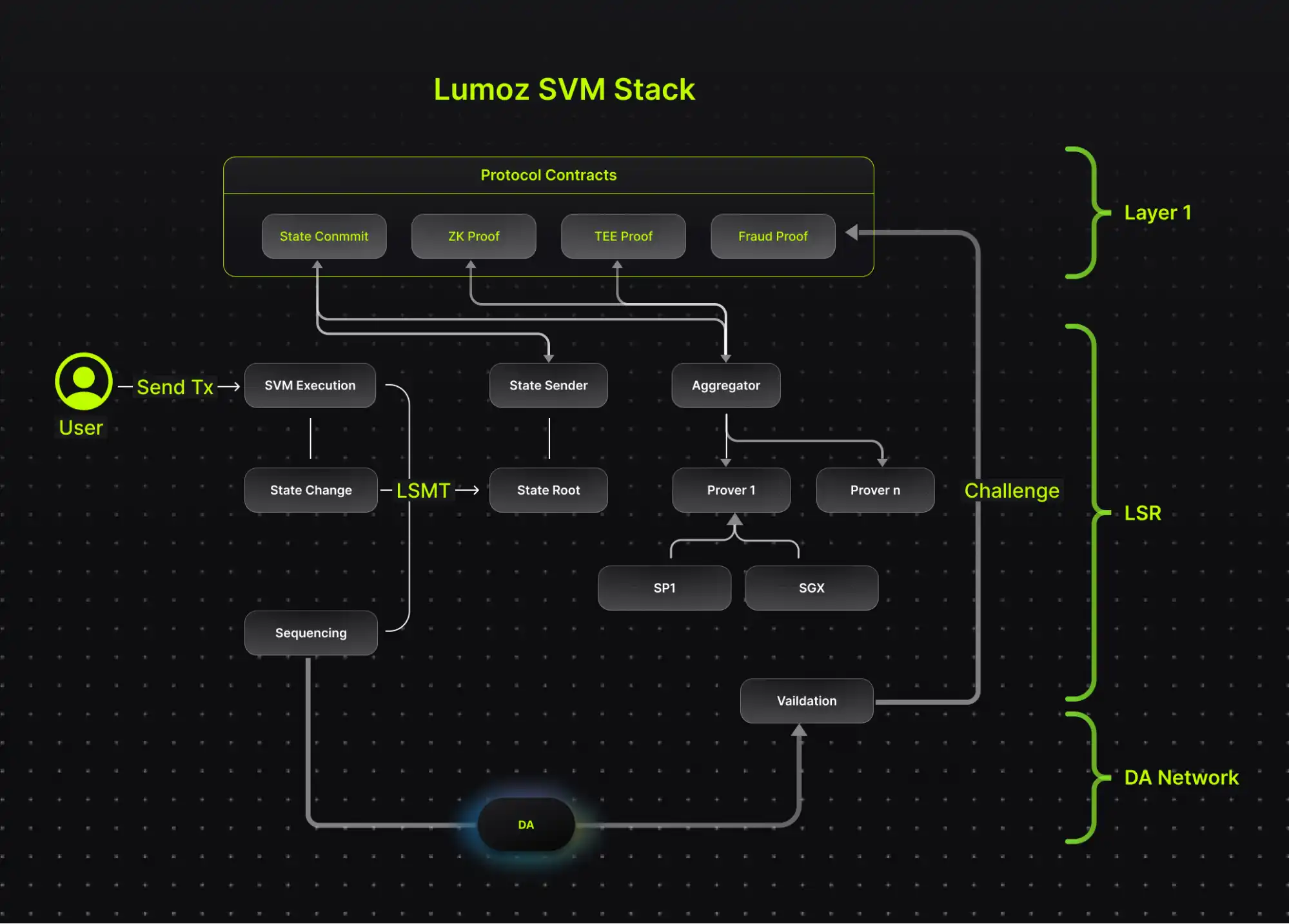
Lumoz SVM Stack is built on the Solana Agave client's code, ensuring compatibility with the Solana mainnet while leveraging Solana's parallel execution capabilities and unique transaction data structure. Through optimization of storage logic and performance parameters, Lumoz SVM Stack maximizes Solana's native performance advantages, further enhancing the system's efficiency and scalability.
The current architecture design allows existing dApps in the Solana ecosystem to seamlessly migrate to the Lumoz SVM Stack network without any modification to the program code. This solution not only reduces the required resources and costs but also maintains consistency with Solana's tools and developer stack, providing developers with lower migration costs and higher development efficiency.
Key Components of the Architecture
· Shared Sorter: The Lumoz SVM Stack adopts a decentralized and transparent transaction sorting approach, ensuring the efficiency and trustworthiness of network scalability. In terms of security, speed, and decentralization, Lumoz SVM Stack exhibits significant advantages. The shared sorter processes multiple transactions in batches, reducing the number of individual transactions the base layer needs to handle, thereby greatly increasing the system's throughput and capacity. Additionally, the Lumoz SVM Stack also provides robust support for transaction sorting, enhancing overall performance.
· Stateless Validator: The stateless validator contract of the Lumoz SVM Stack decomposes the full validation task into small chunks and distributes these tasks to the validator network. Through this design, the Lumoz SVM Stack significantly reduces the hardware requirements of participants, making it easier for nodes to join or exit the network without needing access to the full blockchain state. This not only enhances the system's flexibility but also lowers the entry barriers, promoting more participation of nodes.
· Data Availability: While Solana has strict limits on transaction size, which may pose a challenge for aggregation-based Data Availability (DA) solutions, the Lumoz SVM Stack overcomes the limitations of Solana's native DA solution by extending the DA solution. This design ensures the security and decentralization of data management while retaining the ability to conduct data audits on Solana, ensuring the blockchain's auditability and transparency.
Key Technologies
SVM Compatibility and Parallel Efficient Execution
Solana's SVM (Solana Virtual Machine) is an efficient smart contract execution environment that, with its parallel transaction processing and state-independent design, can execute multiple transactions simultaneously, significantly increasing throughput and reducing latency. SVM supports programming languages like Rust and C, allowing developers to easily build high-performance decentralized applications, driving the rapid development of the Solana ecosystem.
It is worth emphasizing that SVM's parallel execution relies on Solana's unique transaction data structure. In the Solana network, the initiator of each transaction pre-declares the account information to be read from and written to. This design allows SVM to process transactions efficiently in a parallel order based on this account information, ensuring that different transactions do not simultaneously perform read or write operations on the same account. Therefore, simply grafting SVM onto another execution framework does not bring the advantage of parallel processing.
Based on this principle, we have chosen to use the Solana Client as the underlying execution framework to fully leverage SVM's parallel execution advantage, ensuring efficient transaction processing and low-latency performance throughout the system.
Support for Multiple Proofs
Lumoz supports a powerful multi-proof pipeline that can transform assembly-level instructions from different execution clients into arithmetic of algebraic proof systems. This pipeline design enables Lumoz to not only use various backends such as SuperNova, Halo2, and eSTARK to encode arithmetic but also break free from reliance on a single protocol, providing greater flexibility and scalability.
In addition to ZK proofs, Lumoz innovatively leverages SGX to achieve a Trusted Execution Environment (TEE) that generates different types of proofs. The code executed by SGX is the same as the code executed on zkVM, acting similarly to a lightweight execution client. This ensures that all proof systems can verify the same underlying lightweight client execution, enabling potential data reuse. In the SGX environment, necessary data is signed using standard ECDSA signatures, and the signing process is completed using SGX's dedicated private key. The Trusted Execution Environment (TEE) guarantees the confidentiality and integrity of the computation and verifies it through remote attestation.
TEE: Using an Intel SGX CPU, Intel® Software Guard Extensions (SGX) are a set of security-related instructions built into certain Intel CPUs to enable TEE. By using an SGX chip, the chip owner, system operator, and observer gain strong cryptographic assurances, ensuring that no party can view what happens within the Secret memory space.
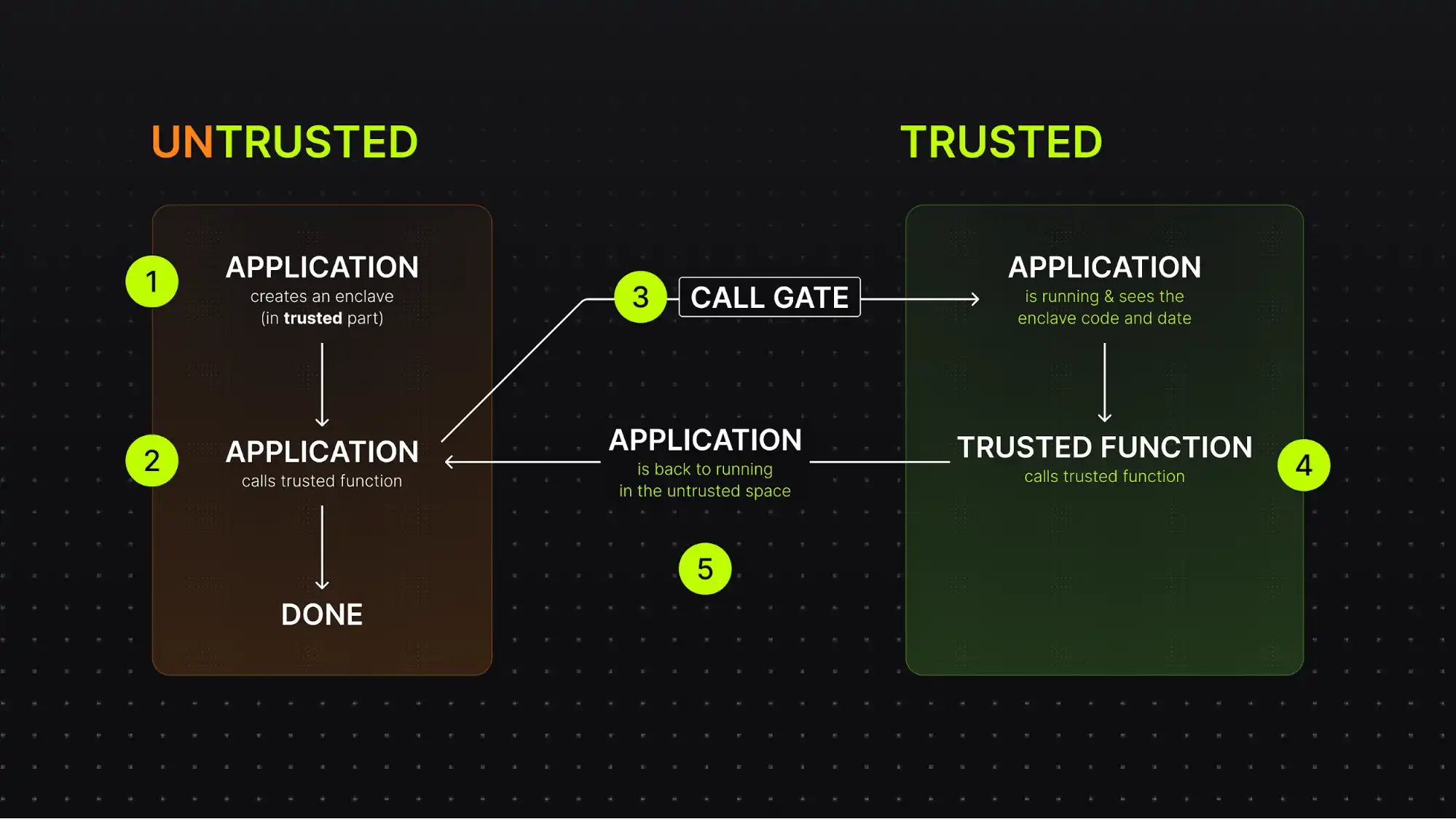
Through this multi-proof pipeline design, Lumoz provides a more efficient, secure, and flexible solution that enhances performance, improves cross-platform and cross-protocol compatibility, and drives innovation in decentralized validation and data security in blockchain technology.
Settlement Protocol Based on Sparse Merkle Tree (LSMT)
Lumoz's Sparse Merkle Tree (LSMT) is an innovative cryptographic data structure that combines the advantages of traditional Merkle trees and Patricia trees, enabling efficient storage of a large number of key-value pairs. Compared to traditional Merkle trees, LSMT only stores necessary nodes through its unique node organization, which are usually nodes containing non-null values or nodes along the path of leaf nodes with values. This design makes LSMT a "sparse" data structure, significantly reducing the storage space requirement.
A significant advantage of LSMT is its ability to provide succinct proofs (Merkle proofs) to verify whether a specific key-value pair is included in the tree without revealing its exact value. This design optimizes storage and computation efficiency, particularly suitable for scenarios requiring efficient data consistency verification.
In Layer 2 solutions, a key application of LSMT is state commitment and state verification. State commitment refers to submitting off-chain transactions (Layer 1 state) to Layer 2 solutions. By submitting this state on Layer 1, participants in Layer 2 can validate the validity of their off-chain transactions without disclosing the entire state or requiring the Layer 1 blockchain to process every off-chain transaction. In this way, LSMT provides an efficient and secure way to achieve cross-chain validation and data commitment, reducing reliance on the base layer and enhancing system scalability and privacy protection.
Conclusion
By innovatively combining various advanced blockchain solutions such as SVM, ZK, and TEE, Lumoz offers an efficient, secure, and flexible SVM general L2/application chain solution. By leveraging the parallel processing advantage of the SVM execution layer and using the Sparse Merkle Tree (LSMT) for data validation, Lumoz is able to significantly increase transaction throughput and processing speed while ensuring security and decentralization. Furthermore, Lumoz's zk and SGX multi-proof pipeline technology provides robust support for secure transaction execution, further improving the efficiency of cross-chain interaction and data processing.
With the continuous development of decentralized applications and blockchain technology, Lumoz's architecture not only provides developers with a more flexible development environment but also effectively reduces transaction costs, driving the application and popularization of blockchain technology in various fields. In the future, Lumoz is poised to become one of the most versatile and scalable Layer 2 solutions, advancing the further development of public chains like Solana and laying a solid foundation for the sustainability and innovation of the blockchain ecosystem.
This article is a submitted contribution and does not represent the views of BlockBeats
You may also like

Uniswap is trapped in an innovation dilemma

What is the key to competition in crypto banking?

The flow of stablecoins and the spillover effects in the foreign exchange market

After two years, Hong Kong's first batch of stablecoin licenses finally issued: HSBC, Standard Chartered make the cut
The person who helped TAO rise by 90% has now single-handedly crashed the price again today

3-Minute Guide to Participating in the SpaceX IPO on Bitget

Top 5 Cryptos to Buy in 2026 Q1: A ChatGPT Deep Dive Analysis
Explore the top 5 cryptos to buy in Q1 2026 including BTC, ETH, SOL, TAO, and ONDO. See price outlooks, key narratives, and institutional catalysts shaping the next market move.

How to Earn $15,000 with Idle USDT Before Altcoin Season 2026
Wondering if altcoin season is coming in 2026? Get the latest market update, and learn how to turn your idle stablecoins waiting for entry into extra rewards up to 15,000 USDT.
Can You Win Joker Returns Without Large Trading Volume? 5 Mistakes New Players Make In WEEX Joker Returns Season 2
Can small traders win WEEX Joker Returns 2026 without huge volume? Yes—if you avoid these 5 costly mistakes. Learn how to maximize card draws, use Jokers wisely, and turn small deposits into 15,000 USDT rewards.

Altcoin Season 2026: 4 Stages to Profit (Before the Crowd FOMO In)
Altcoin Season 2026 is starting — discover the 4 key stages of capital rotation (from ETH to PEPE) and how to position before the peak. Learn which tokens will lead each phase and avoid missing the rally.

Will Alt season come in 2026? 5 Tips to Spot the Next 100x Crypto Opportunities
Will altcoin season arrive in 2026? Discover 5 rotation stages, early signals smart traders watch, and the key crypto sectors where the next 100x altcoin opportunities may emerge.

The bear market has arrived, and cryptocurrency ETF issuers are also getting involved

The richest man had a quarrel with his former boss

BTC Firm Above 70K! Saylor’s "Institutional Logic" vs. Moon’s "Retail Faith": Who is Really Harvesting the Market?
Bitcoin is holding firm above the $70,000 support level following a massive short squeeze that liquidated $427 million. As the "Four-Year Cycle" narrative shifts, the market is split: Michael Saylor’s cold, institutional "indiscriminate stacking" vs. Carl Moon’s high-energy retail "hopium." This article decodes these two polar-opposite strategies for the 2026 bull run and reveals how WEEX’s institutional-grade liquidity and AI trading tools empower every type of investor to convert market volatility into profit.

The Girl Who Created the SBTI Test: A Story of a Doomed Cyber Love, an E-Widow Ratfolk

B.AI Officially Launched: Building AI Agent Financial Bedrock Platform, Driving AGI Era Business Underlying Logic

B.AI Officially Launched: Breaking Down A2A Collaboration Barriers to Unlock the Smart Body Economy's Full Potential


 App
App