
 Buy Crypto
- Markets
 Futures
- Spot
- Copy Trade
- Earn
- More
The person who helped TAO rise by 90% has now single-handedly crashed the price again today

Original Title: "The Person Who Helped TAO Surge 90% Today Personally Crashed the Price Again"
Source: DeepTech TechFlow
TAO suddenly plummeted by 15% today, now trading at around $277, with a downward trend.
The cause of the sudden price drop may be an open letter.
The letter was written by Sam Dare, the founder of Covenant AI. Bittensor is currently the highest-valued project in the AI+Crypto track, and Covenant AI is the most important subnet team in its ecosystem.
Just last month, this team achieved a major milestone by running a 72B parameter mega-model called Covenant-72B using civilian hardware from over 70 contributors, claiming to be the largest decentralized AI training ever.
A month ago, this event made TAO the brightest narrative in the entire crypto circle, exuding a sense of AI glory.
NVIDIA CEO Jensen Huang publicly praised it, and Silicon Valley prominent investor Chamath mentioned it on his podcast. The price of $TAO even surged by 90% in a month, shining brightly in the current bear market environment.
However, today, Sam Dare announced the departure of the team from Bittensor, conveniently dismantling the foundation of this narrative.
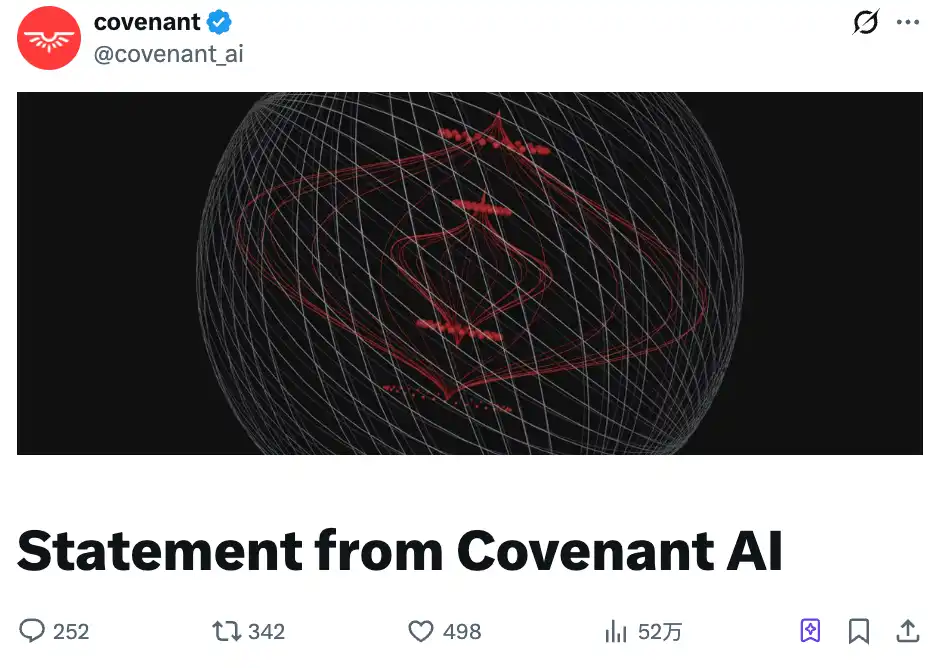
Sam Dare's open letter is lengthy, but the core allegation revolves around one thing:
Bittensor's founder Jacob Steeves (commonly known as Const within the circle) single-handedly controls the entire network, decentralization is just a facade.
In the letter, he listed a series of actions, with the harshest being the direct suspension of the Covenant subnet's emissions, essentially reducing the team's income to zero; and engaging in significant token sales during the conflict period to apply pressure, using market tactics to force compliance.
The newly launched whistleblower website Tao Papers today provided even stronger evidence. According to on-chain data disclosed by the website, from 2023 to 2026, Bittensor underwent a total of 41 network upgrades, with 38 of them going from proposal to signing to deployment, all from infrastructure controlled by Const, with the other two signers co-signing within minutes each time, without any public discussion records.
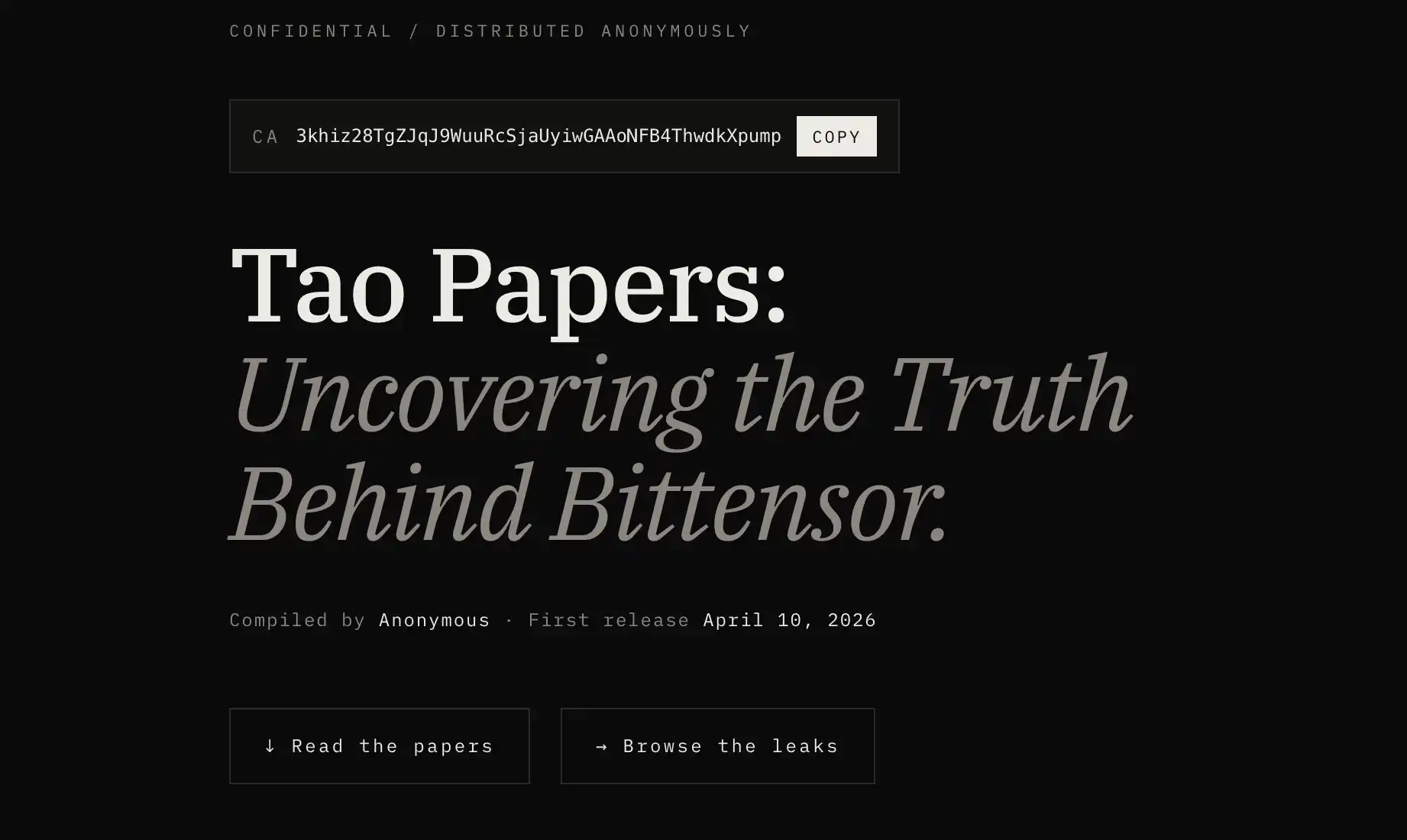
The so-called three-person "governance committee" is actually one person making decisions, with the other two providing endorsements.
The public letter and whistleblower website went live on the same day, clearly indicating that Sam's actions were not impulsive.
Correspondingly, just two months ago, Bittensor's founder, Const, announced his resignation as the CEO of the Opentensor Foundation (the development foundation behind Bittensor), citing a push for decentralization.
Simultaneously, after Sam announced his departure, on-chain data also revealed that he had sold all of his 37,000 TAO tokens, triggering further market FUD.
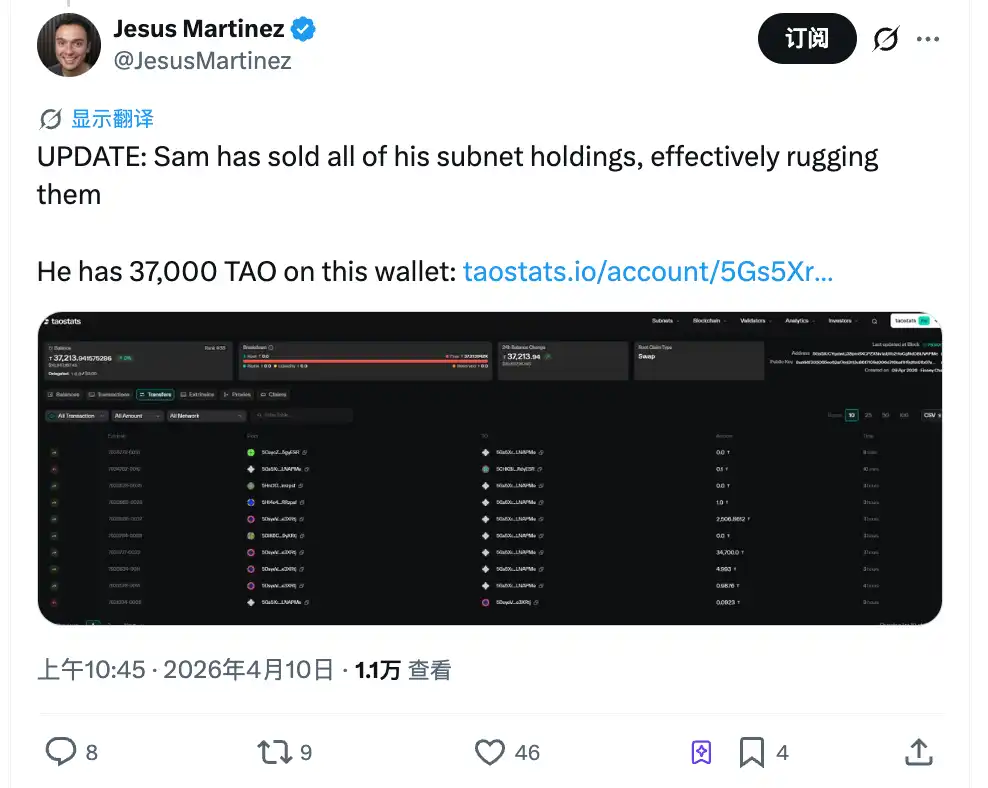
As of now, Const's only response to all this is a statement that essentially implies Covenant's departure is actually a good thing, as it can give rise to a team-independent, self-running subnet.
As for the accusations listed by Sam Dare, not a single word has been responded to. However, whether it's a public feud or contributions, it has already been priced in by the market.
In March, $TAO rose from around $170 to $337, nearly doubling. According to The Block, two weeks after Covenant-72B was released, TAO surged by over 50%, marking the largest single catalyst in the entire 90% rally.
CovenantAI is associated with Templar, Basilica, and Grail (sn3, sn39, and sn81), and the subnet tokens are linked to TAO through a staking mechanism. Upon the release of Covenant-72B, subnet tokens saw up to a 400% increase, pulling TAO along with them.
So, those buying TAO are ostensibly buying into a decentralized AI network with over a hundred subnets, but the price structure tells a different story, with almost half of the surge attributed to a single team.
Success is Covenant, failure is also Covenant. This sentence has been mentioned by many people today, but most only see the surface meaning.
What is more worth pondering is why a network claiming to have 125 subnets, when rising, relies on a few subnets to drive up the price, and when falling, also relies on the drama of a few subnets to push the price down. More subnets are almost invisible in these two market cycles.
Bittensor's decentralized narrative has been sold for three years, and the price structure always seems centralized. As for who is right or wrong in the conflict itself, the author doesn't think that's the point.
Any ecosystem will have star teams, and any star team may also leave.
The hard part is how you deal with this.
In a bear market, team infighting in crypto projects is not uncommon. When the market lacks hotspots, whether a project goes up or not depends entirely on whether there is a narrative to hype. Covenant-72B is one of the best narratives this year, endorsed by Huang Renxun, doubling in TAO, and everyone in the community thinks that decentralized AI has finally produced a competitive player.
But there is a natural issue with narrative-driven price increases—those who create the narrative can also destroy it. When it rises, it is the light of crypto; when it falls, it is the team fleeing. For those who bought TAO, the 90% you earned and the 15% you lost today come from the same source.
This may be the most genuine investment dilemma in crypto right now. The price always follows a narrative that emerged who knows when, and the narrative is tied to certain key individuals.
While people are around, the story is there; when people leave, you may not even find a counterpart to trade with.
You may also like

Uniswap is trapped in an innovation dilemma

What is the key to competition in crypto banking?

The flow of stablecoins and the spillover effects in the foreign exchange market

After two years, Hong Kong's first batch of stablecoin licenses finally issued: HSBC, Standard Chartered make the cut

3-Minute Guide to Participating in the SpaceX IPO on Bitget

Top 5 Cryptos to Buy in 2026 Q1: A ChatGPT Deep Dive Analysis
Explore the top 5 cryptos to buy in Q1 2026 including BTC, ETH, SOL, TAO, and ONDO. See price outlooks, key narratives, and institutional catalysts shaping the next market move.
How to Earn $15,000 with Idle USDT Before Altcoin Season 2026
Wondering if altcoin season is coming in 2026? Get the latest market update, and learn how to turn your idle stablecoins waiting for entry into extra rewards up to 15,000 USDT.
Can You Win Joker Returns Without Large Trading Volume? 5 Mistakes New Players Make In WEEX Joker Returns Season 2
Can small traders win WEEX Joker Returns 2026 without huge volume? Yes—if you avoid these 5 costly mistakes. Learn how to maximize card draws, use Jokers wisely, and turn small deposits into 15,000 USDT rewards.

Altcoin Season 2026: 4 Stages to Profit (Before the Crowd FOMO In)
Altcoin Season 2026 is starting — discover the 4 key stages of capital rotation (from ETH to PEPE) and how to position before the peak. Learn which tokens will lead each phase and avoid missing the rally.

Will Alt season come in 2026? 5 Tips to Spot the Next 100x Crypto Opportunities
Will altcoin season arrive in 2026? Discover 5 rotation stages, early signals smart traders watch, and the key crypto sectors where the next 100x altcoin opportunities may emerge.

The bear market has arrived, and cryptocurrency ETF issuers are also getting involved

The richest man had a quarrel with his former boss

BTC Firm Above 70K! Saylor’s "Institutional Logic" vs. Moon’s "Retail Faith": Who is Really Harvesting the Market?
Bitcoin is holding firm above the $70,000 support level following a massive short squeeze that liquidated $427 million. As the "Four-Year Cycle" narrative shifts, the market is split: Michael Saylor’s cold, institutional "indiscriminate stacking" vs. Carl Moon’s high-energy retail "hopium." This article decodes these two polar-opposite strategies for the 2026 bull run and reveals how WEEX’s institutional-grade liquidity and AI trading tools empower every type of investor to convert market volatility into profit.

The Girl Who Created the SBTI Test: A Story of a Doomed Cyber Love, an E-Widow Ratfolk

B.AI Officially Launched: Building AI Agent Financial Bedrock Platform, Driving AGI Era Business Underlying Logic

B.AI Officially Launched: Breaking Down A2A Collaboration Barriers to Unlock the Smart Body Economy's Full Potential
We helped Xu Mingxing write a book called "<OK Life>".

Rare APY of 400%, is TradeXYZ handing out money to oil bulls?
Uniswap is trapped in an innovation dilemma
What is the key to competition in crypto banking?
The flow of stablecoins and the spillover effects in the foreign exchange market
After two years, Hong Kong's first batch of stablecoin licenses finally issued: HSBC, Standard Chartered make the cut
3-Minute Guide to Participating in the SpaceX IPO on Bitget
Top 5 Cryptos to Buy in 2026 Q1: A ChatGPT Deep Dive Analysis
Explore the top 5 cryptos to buy in Q1 2026 including BTC, ETH, SOL, TAO, and ONDO. See price outlooks, key narratives, and institutional catalysts shaping the next market move.


 App
App