
GitHub Security: What the VS Code Extension Breach Means




GitHub security came under fresh scrutiny after the company confirmed that an employee device was compromised through a poisoned VS Code extension, leading to unauthorized access and exfiltration of GitHub internal repositories. As of May 21, 2026, GitHub's current assessment is that the activity affected internal repositories only, while attacker claims of about 3,800 repositories are broadly aligned with the company's investigation.
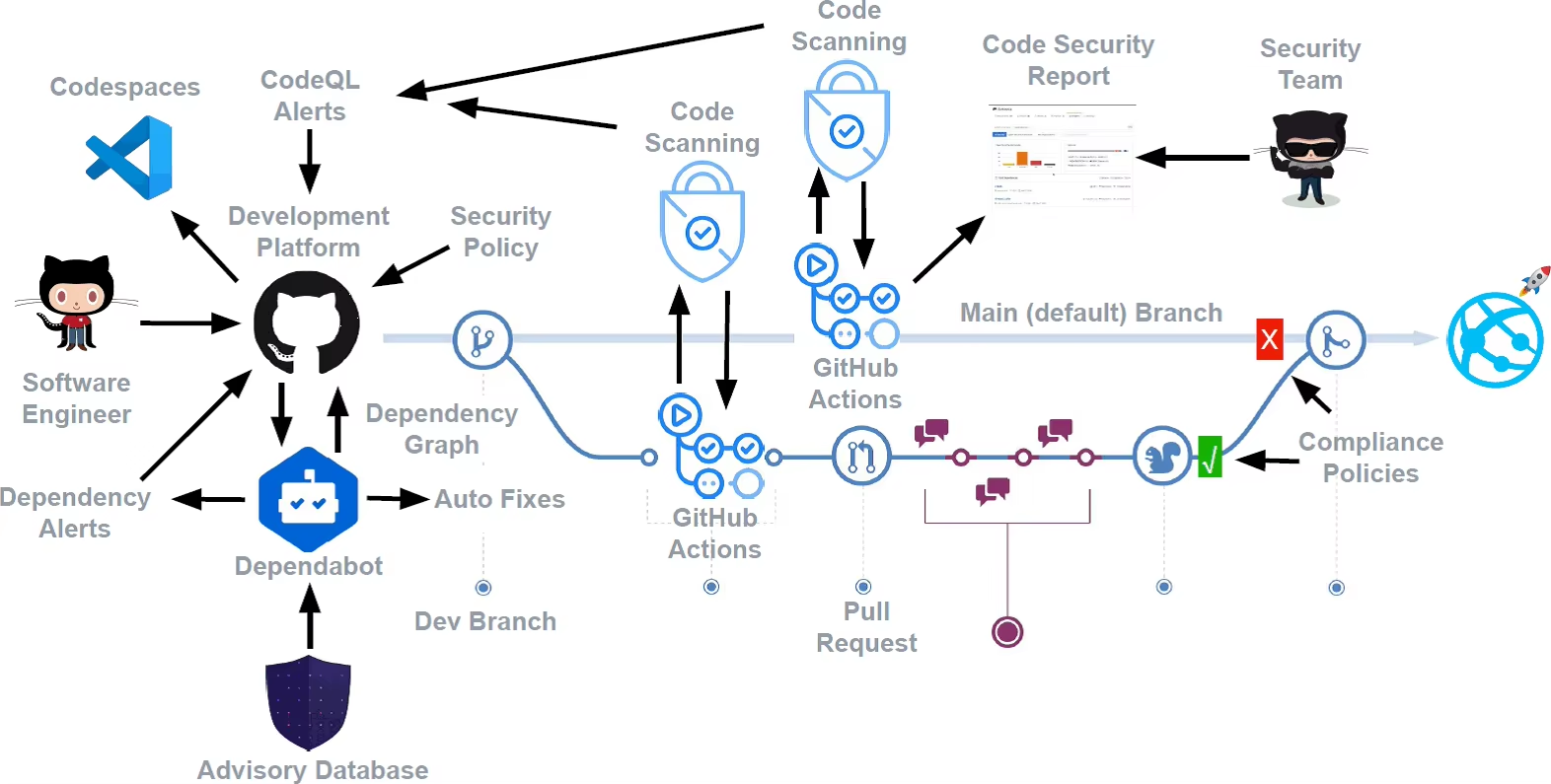
The bigger point is not just that GitHub was targeted. It is that modern software supply-chain attacks increasingly start with the tools developers trust most: code editors, extensions, package managers, CI/CD tokens, and endpoint credentials. For crypto exchanges, wallets, market makers, infrastructure providers, and protocol teams, that makes GitHub security a direct operational risk, not a back-office IT issue.
What Happened In The GitHub Security Incident?
GitHub said it detected and contained the compromise of an employee endpoint involving a malicious VS Code extension. The company removed the malicious extension version, isolated the affected device, launched incident response, rotated critical credentials with priority given to higher-impact secrets, and continued reviewing logs for follow-on activity.
| Detail | Current Status As Of May 21, 2026 |
|---|---|
| Initial vector | Poisoned VS Code extension on an employee device |
| Affected assets | GitHub internal repositories |
| Approximate scale | Attacker claims of about 3,800 repositories align with GitHub's current assessment |
| Customer data | No confirmed impact outside GitHub internal repositories at the time of reporting |
| GitHub response | Extension removal, endpoint isolation, credential rotation, log analysis, monitoring |
| Full report | GitHub said a fuller incident report will follow after investigation |
The extension has not been publicly named in the reporting reviewed. That matters because teams should avoid assuming the issue is solved by blocking one known package. The more useful lesson is broader: editor extensions can run with significant local access, and a trusted-looking development tool can become a credential collection point.
Why A VS Code Extension Can Become A Serious Attack Path
VS Code extensions are powerful because they sit close to source code, terminals, package managers, environment variables, SSH keys, cloud credentials, and local project files. Microsoft's own VS Code documentation notes that extensions run through the extension host with the same permissions as VS Code itself. Workspace Trust can reduce some automatic code execution risk, but it cannot fully neutralize a malicious extension once a user installs and runs it.
For crypto teams, this is especially sensitive. A compromised developer workstation may expose deployment scripts, RPC keys, exchange API credentials, signing infrastructure references, private package tokens, or CI secrets. Even if no customer wallet is directly touched, internal source code can give attackers a map of where to look next.
This is why account and device security should include developer tooling, not only wallet hygiene and phishing awareness.
Why GitHub Security Matters To Crypto Companies
Crypto businesses run on code, keys, and trust boundaries. A GitHub security incident involving internal repositories is not the same as a confirmed user-fund loss, but internal code exposure can still matter in practice.
Attackers use stolen repositories to understand architecture, identify dependency weaknesses, search for hardcoded secrets, map build pipelines, and plan targeted phishing against maintainers. If a repository contains old credentials, test keys with unexpected privileges, deployment notes, or support excerpts, the risk can grow after the initial breach.
For crypto teams, the harder lesson is that a developer convenience can quietly become a production risk. Teams that maintain trading systems, custody workflows, smart contracts, or exchange integrations should treat endpoint compromise as a potential supply-chain event, not merely a laptop cleanup task.
Practical GitHub Security Controls Teams Should Review
The strongest response is layered. No single control stops every malicious extension, but several controls can reduce blast radius.
| Control | Why It Matters |
|---|---|
| Approved extension allowlist | Reduces exposure to unknown or newly compromised extensions |
| Verified publisher checks | Helps avoid impersonation and low-trust packages |
| Least-privilege repository access | Limits what one endpoint or account can reach |
| Short-lived credentials | Reduces value of stolen tokens |
| Secret scanning and rotation drills | Finds exposed credentials before attackers reuse them |
| Separate production access | Keeps developer workstations away from high-impact systems |
| CI/CD token review | Prevents build pipelines from becoming lateral movement paths |
| Endpoint telemetry | Detects unusual file access, exfiltration, and outbound traffic |
In practice, the failure point is often stale access. A developer gets broad repository permissions for a deadline, keeps them indefinitely, installs a useful extension, and later that extension or its update becomes hostile. Good GitHub security is partly about making sure one normal workstation mistake cannot expose the whole organization.
Crypto operators should pair repository controls with risk management practices, especially when engineering access intersects with market infrastructure or customer-facing systems.
What Individual Developers Should Do Now
Developers should review installed VS Code extensions, remove anything unnecessary, check publisher history, and be cautious with new extensions that request broad access or have sudden ownership changes. Teams should also review whether extensions auto-update without internal approval.
For repositories that handle wallets, bots, exchange API keys, signing code, or trading infrastructure, developers should inspect .vscode settings, tasks, launch configurations, package lockfiles, and scripts that run automatically. The same caution applies to AI coding tools and agents that can read files, run commands, or interact with terminals.
A cleaner setup is not glamorous, but it is usually cheaper than post-incident credential rotation across dozens of systems. Traders and builders using exchange infrastructure should also separate code experimentation from live trading accounts and production keys before interacting with spot markets.
Conclusion
The GitHub security incident shows that developer tools are now part of the attack surface. The immediate facts point to internal repository exfiltration through a poisoned VS Code extension, with GitHub rotating credentials and continuing its investigation. The strategic lesson is broader: source code platforms, editor extensions, package managers, and CI systems are all part of the same trust chain.
For crypto teams, the right response is not panic. It is reducing the blast radius of ordinary developer activity. Review extension policies, tighten repository access, rotate sensitive credentials, monitor endpoints, and assume that attackers are studying the tools your engineers use every day.
FAQ
Was customer data affected in the GitHub security incident?
GitHub's current assessment says the activity involved GitHub internal repositories only, with no confirmed impact to customer information stored outside those repositories as of May 21, 2026.
Did GitHub name the malicious VS Code extension?
The reports reviewed did not identify the extension publicly. Teams should focus on extension governance broadly rather than waiting for one package name.
Why are VS Code extensions risky?
VS Code extensions can run with meaningful local permissions and may access project files, development workflows, and credentials available to the editor environment.
What should crypto teams check first?
Start with installed extensions, repository permissions, exposed secrets, CI/CD credentials, endpoint logs, and any developer accounts with access to production or custody-related systems.
Risk Warning
Crypto assets are volatile and may result in partial or total loss. Security incidents can also create indirect trading and custody risks, including delayed withdrawals, compromised API keys, exposed infrastructure, liquidity disruption, smart-contract deployment errors, and counterparty risk. Always separate development credentials from trading or custody access, and avoid using leverage or live funds when security status is uncertain.
You may also like

If You Can’t Buy META Stocks, What Are the Trading Alternatives?
If you can’t open a US brokerage or fund one easily, you can still get META (Meta Platforms)…

Can CDOF Reach $0.001? What Investors Should Know
CDOF positions itself as a “digital oil” token on Solana. The project’s own materials describe a model inspired…
Is CDOF Just Hype? What Investors Should Know
CDOF markets itself as a Solana-based “digital oil fund” that borrows ideas from strategic petroleum reserves: supply security,…
Why Is CDOF Trending? What’s Driving the Recent Attention?
CDOF is drawing attention because it blends a hot energy narrative with Solana’s fast, low-fee rails. The project…
Does CDOF Have Real Oil Backing? What Investors Should Know
CDOF markets a “digital oil” story on Solana, borrowing ideas from strategic reserves and on-chain transparency. This guide…

How to Buy CDOF Crypto: A Beginner’s Guide
CDOF is a Solana-based “digital oil” narrative token that references strategic reserves, supply security, and transparent on-chain reporting.…

CDOF vs SAOS: Which Narrative Is Driving More Attention?
This article breaks down two fast-moving crypto narratives—CDOF and SAOS—and shows how to judge where attention, liquidity, and…
CDOF vs Tether Gold: Digital Oil vs Digital Gold Explained
This guide breaks down CDOF (a “digital oil” token concept) versus Tether Gold (XAUT), the leading “digital gold”…

CDOF vs NOAR: What’s the Difference?
This guide explains how to evaluate CDOF vs NOAR side by side without guesswork. You’ll learn what to…
Can NOAR Reach $0.0001? What Investors Should Know
This article breaks down what NOAR is, how its “energy” narrative fits the market, and what would need…

Is NOAR Worth Buying in 2026? Risks and Opportunities Explained
NOAR (Northern Oil Asset Reserve) is a Solana-based token that leans on an oil and energy narrative while…
If You Can’t Buy Adobe (ADBE) Stocks, What Are the Trading Alternatives?
If you want exposure to Adobe (ADBE) but can’t open a US brokerage account, this guide maps your…
Are NFTs Still Worth Buying in 2026? Trends and Risks Explained
NFT markets look different in 2026. Hype cycles have cooled, and utility-focused projects—gaming items, tickets, brand memberships, and…

If You Can’t Buy AAOI Stocks, What Are the Trading Alternatives?
If you’re tracking AAOI but can’t open a US brokerage account, this guide breaks down practical routes to…
If You Can’t Buy Chipotle (CMG) Stocks, What Are the Trading Alternatives?
If you can’t access Chipotle (CMG) on a US broker, you still have ways to trade CMG’s price…
Can SPCX Reach $250 in 2026? SpaceX Price Prediction
KEY TAKEAWAYS SPCX trades near $195 today, based on aggregated tokenized-market trackers that mirror SpaceX’s private valuation dynamics.…
Qualcomm Share Price: 2026 Outlook, Catalysts and Access
The Qualcomm share price trades in the low-$200s in mid-June 2026. See QCOM's price, analyst targets, the June 24 catalyst, and how to trade it.
Is Techsslaash.com Legit? What It Is and What to Watch in 2026
Is Techsslaash.com legit? A 2026 review of the tech/fintech content site, its creator-reward model, traffic red flags, and how to vet it safely.
If You Can’t Buy META Stocks, What Are the Trading Alternatives?
If you can’t open a US brokerage or fund one easily, you can still get META (Meta Platforms)…
Can CDOF Reach $0.001? What Investors Should Know
CDOF positions itself as a “digital oil” token on Solana. The project’s own materials describe a model inspired…
Is CDOF Just Hype? What Investors Should Know
CDOF markets itself as a Solana-based “digital oil fund” that borrows ideas from strategic petroleum reserves: supply security,…
Why Is CDOF Trending? What’s Driving the Recent Attention?
CDOF is drawing attention because it blends a hot energy narrative with Solana’s fast, low-fee rails. The project…
Does CDOF Have Real Oil Backing? What Investors Should Know
CDOF markets a “digital oil” story on Solana, borrowing ideas from strategic reserves and on-chain transparency. This guide…
How to Buy CDOF Crypto: A Beginner’s Guide
CDOF is a Solana-based “digital oil” narrative token that references strategic reserves, supply security, and transparent on-chain reporting.…


