
- Buy Crypto
- Markets
 Futures
- Spot
- Copy Trade
- Earn
- More
Wall Street's Abacus: $500 Million to Buy Ripple, What Gives?

Original Article Title: "Wall Street's Abacus: $5 Billion to Buy Ripple What?"
Original Article Author: Seed.eth, BitpushNews
In November 2025, Ripple Labs announced a $5 billion new round of strategic financing, raising the company's valuation to $400 billion. This is the first public fundraising for this cryptocurrency financial company in six years and the largest capital injection since the Series C funding in 2019.
More importantly, the capital faction behind this round of financing is extraordinary: Wall Street's two giants, Fortress Investment Group and Citadel Securities, led the investment, joined by renowned institutions such as Pantera Capital, Galaxy Digital, Brevan Howard, Marshall Wace, and others.
For those familiar with Ripple, this can be considered a "comeback"—is this still the Ripple that was once deeply mired in the mud due to an SEC lawsuit, and even at one point considered a "zombie company"?
From "Master Storyteller" to "Compliance Heavyweight"
Ripple was founded in 2012 and is one of the oldest projects in the crypto community. Its core technology is the XRP Ledger, a decentralized ledger designed for cross-border payments. Ripple Labs has developed payment and settlement systems based on this ledger, and the XRP token was once popular globally from 2017 to 2018, ranking in the top three by market cap, following only Bitcoin and Ethereum.
However, as the token price plummeted and the truth about "pumped" partnerships emerged, Ripple's narrative of "bank-grade partnerships" began to crumble.
During this period, Forbes published an article directly pointing out that Ripple's core business model might be a "pump-and-dump" scheme: Ripple used its massive XRP holdings to spend money on partnerships, creating a false prosperity, and used vague language to evade regulation. Its ultimate goal was not to truly promote the technology but to inflate the value of its freely obtained tokens through marketing and hype, so that insiders could eventually cash out and profit.
In December 2020, the regulatory hammer came down.
The U.S. Securities and Exchange Commission (SEC) sued Ripple for "unregistered securities offering," alleging that it illegally raised over $1.3 billion through XRP.
This marked one of the most significant regulatory battles in the crypto industry.
The ripple effects of the lawsuit were devastating: Mainstream exchanges like Coinbase and Kraken swiftly delisted XRP; longtime partner MoneyGram terminated its relationship; XRP's price plummeted over 60% in the following month. Ripple not only suffered business-wise but was also completely blacklisted from compliance.
Strategic Transformation
While this years-long legal battle cost Ripple nearly $200 million in legal fees, it also granted the company crucial breathing room and some favorable court rulings, buying them valuable time for a strategic transformation.
In 2024, Ripple officially launched RLUSD, a USD-pegged stablecoin, focusing on compliance and targeting financial institution payments and settlements. Unlike USDT and USDC, RLUSD is not meant for inter-exchange "stablecoin" trading but aims to enter traditional credit card and cross-border settlement systems.
In 2025, Ripple announced partnerships with Mastercard, WebBank, Gemini, among others, to use RLUSD for real-time credit card settlements, becoming the world's first blockchain-based stablecoin to enter card networks.
This not only opened up the B2B channel for stablecoin applications but also paved the way for Ripple's integration with the real-world financial system.
To build a comprehensive on-chain financial capability, Ripple carried out a series of targeted acquisitions between 2023-2025:
· Acquired Metaco: Gained institutional-grade digital asset custody technology, laying the foundation to serve large financial institutions.
· Acquired Rail: Obtained stablecoin issuance and management systems, accelerating the launch of RLUSD.
· Secured Hidden Road: Completed the puzzle of institutional credit networks and cross-border settlement capabilities.
Through these acquisitions, Ripple's system capabilities have evolved from a single cross-border payment system to a full-stack financial infrastructure encompassing "stablecoin issuance + institutional custody + cross-chain settlement."
The Truth Behind the $40 Billion Valuation
On the surface, Ripple's transformation path seems to be getting wider.
However, the old players in the capital market see a different picture.
To understand the true logic behind this funding, one must see Ripple's essence: a massive "digital asset treasury."
At XRP's inception, 80% of the 100 billion tokens were placed under Ripple's custody. As of now, the company still holds 34.76 billion tokens, with a nominal value of over $80 billion based on market price—twice its funding valuation.
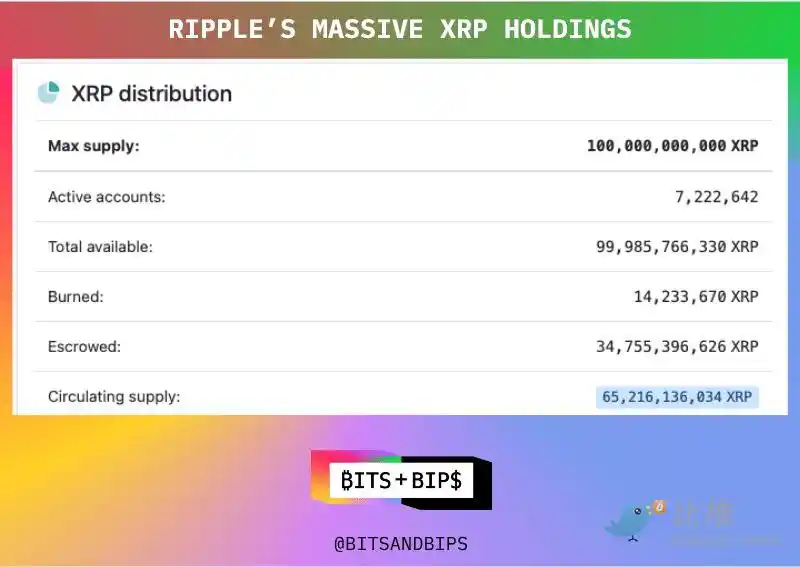
According to multiple venture capitalists, the $500 million transaction is closely tied to purchasing Ripple's XRP holdings and likely at a price far below the spot price.
From an investment perspective, investors effectively acquired an asset at 0.5x mNAV (Market Value to Net Asset Value ratio). Even with a 50% liquidity discount on XRP holdings, the value of these assets still matches the company's valuation.
An insider familiar with the situation told Unchained, "Even if they can't successfully build their own business, they can just buy another company outright."
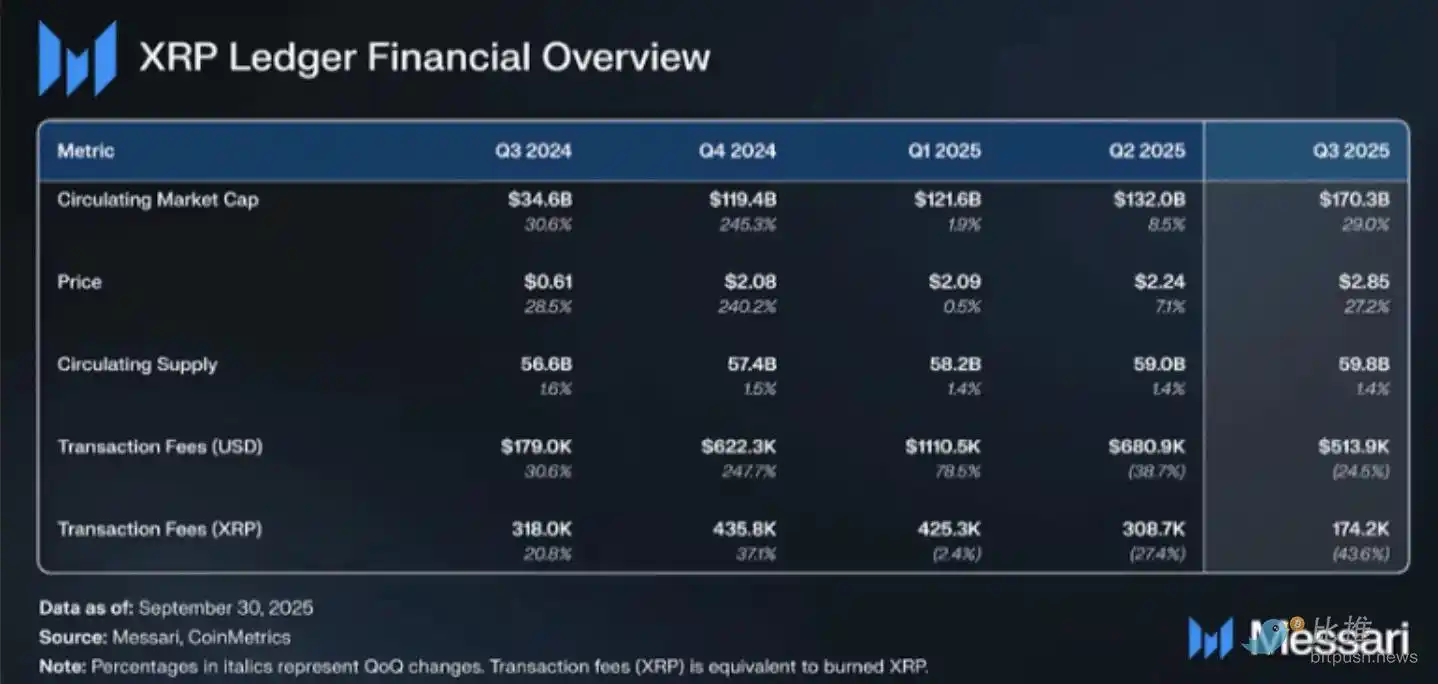
A venture capitalist stated, "This company has no value other than holding XRP. No one is using their tech, and there is no interest in their network/blockchain."
Another community member stated, "Ripple's equity itself may not be worth much, certainly not $40 billion."
A participant revealed the true logic, "The payments track is too hot right now, and investors need to bet on multiple horses on the track."
Ripple is just one horse—a horse that may have average technology but an extremely well-fed (XRP reserve) horse.
And for Ripple, this is a win-win situation:
· Solidify Valuation: Officializing the $40 billion valuation from the private market to provide a pricing benchmark for early investors to exit.
· Avoiding Dumping: Using funding cash for acquisitions to avoid selling XRP and causing market impact.
Ripple co-founder Chris Larsen's personal wealth has also surged to around $15 billion.
From this perspective, Ripple's story has turned into one of the most classical financial tales: about assets, about valuation, about liquidity management.
From the defendant's seat of the SEC to Wall Street's boardrooms, Ripple's journey is a microcosm of the entire crypto industry's transition from idealism to realism. If the past Ripple was the pinnacle of "narrative economics," today's Ripple demonstrates how, as the tide recedes, project teams rely on the most primitive capital strength to achieve a "soft landing."
You may also like

Who's at the CFTC Table? A Rebalancing of American Fintech Discourse

AI Trading vs Human Crypto Traders: $10,000 Live Trading Battle Results in Munich, Germany (WEEX Hackathon 2026)
Discover how AI trading outperformed human traders in WEEX's live Munich showdown. Learn 3 key strategies from the battle and why AI is changing crypto trading.

Elon Musk's X Money vs. Crypto's Synthetic Dollars: Who Wins the Future of Money?
How do Synthetic Dollars work? This guide explains their strategies, benefits over traditional stablecoins like USDT, and risks every crypto trader must know.

The Israeli military is hunting a mole on Polymarket

Q4 $667M Net Loss: Coinbase Earnings Report Foreshadows Challenging 2026 for Crypto Industry?

BlackRock Buying UNI, What's the Catch?

Lost in Hong Kong

Gold Plunges Over 4%, Silver Crashes 11%, Stock Market Plummet Triggers Precious Metals Algorithmic Selling Pressure?

Coinbase and Solana make successive moves, Agent economy to become the next big narrative

Aave DAO Wins, But the Game Is Not Over
Coinbase Earnings Call, Latest Developments in Aave Tokenomics Debate, What's Trending in the Global Crypto Community Today?
ICE, the parent company of the NYSE, Goes All In: Index Futures Contracts and Sentiment Prediction Market Tool

On-Chain Options: The Crossroads of DeFi Miners and Traders

How WEEX and LALIGA Redefine Elite Performance
WEEX x LALIGA partnership: Where trading discipline meets football excellence. Discover how WEEX, official regional partner in Hong Kong & Taiwan, brings crypto and sports fans together through shared values of strategy, control, and long-term performance.

Best Crypto to Buy Now February 10 – XRP, Solana, Dogecoin
Key Takeaways XRP is set to revolutionize cross-border transactions, potentially reaching $5 by the end of Q2 with…
Kyle Samani Criticizes Hyperliquid in Explosive Post-Departure Market Commentary
Key Takeaways: Kyle Samani, former co-founder of Multicoin Capital, publicly criticizes Hyperliquid, labeling it a systemic risk. Samani’s…
Leading AI Claude Forecasts the Price of XRP, Cardano, and Ethereum by the End of 2026
Key Takeaways: XRP’s value is projected to reach $8 by 2026 due to major institutional adoption. Cardano (ADA)…
Bitcoin Price Prediction: Alarming New Research Cautions Millions in BTC at Risk of ‘Quantum Freeze’ – Are You Ready?
Key Takeaways Quantum Threat to Bitcoin: The rise of quantum computing presents a unique security challenge to Bitcoin,…
Who's at the CFTC Table? A Rebalancing of American Fintech Discourse
AI Trading vs Human Crypto Traders: $10,000 Live Trading Battle Results in Munich, Germany (WEEX Hackathon 2026)
Discover how AI trading outperformed human traders in WEEX's live Munich showdown. Learn 3 key strategies from the battle and why AI is changing crypto trading.
Elon Musk's X Money vs. Crypto's Synthetic Dollars: Who Wins the Future of Money?
How do Synthetic Dollars work? This guide explains their strategies, benefits over traditional stablecoins like USDT, and risks every crypto trader must know.


 App
App