
- Buy Crypto
- Markets
 Futures
- Spot
- Copy Trade
- Earn
- More
Wall Street Bears Target Ethereum: Vitalik In the Know Takes Flight, Tom Lee Remains Bullish

Original Source: Culper Research
Original Translation: Azuma, Odaily Planet Daily
Editor's Note: On March 6, the Wall Street short-selling firm Culper Research suddenly published an article announcing that they were shorting ETH and BMNR-related securities. Culper Research's logic is that developers like Vitalik miscalculated Ethereum's demand elasticity before the Fusaka upgrade, leading to the upgrade breaking ETH's tokenomics. Culper Research also mentioned that Vitalik is well aware of this and is taking practical action to front-run it, while the stubborn Tom Lee is heading towards a dead end.
In response to this large-scale short by the institution, Vitalik himself and Tom Lee have not yet responded, but Vitalik's father Dmitry Buterin (dima.eth) responded by saying, "When you see the phrase 'Vitalik knows this and is selling,' you don't need to read further. They are clowns eager for attention, not researchers."
Below is the original content from Culper Research, translated by Odaily Planet Daily. Translating this article does not imply our endorsement of Culper Research's views, but is merely to present part of the Wall Street institutional perspective on ETH and market manipulation.

It has been disclosed that we are shorting ETH and ETH-related stocks, including Bitmine (BMNR).
We believe that after the Fusaka upgrade in December 2025, Ethereum's tokenomics has been disrupted. Vitalik is well aware and is selling off; meanwhile, ETH's staunchest bull Tom Lee continues to add to futile investments. ETH will continue to decline.
Tom Lee's Bitmine has been defending ETH, claiming that "due to increasing utility, ETH is not in a death spiral." He cited the surge in Ethereum's active addresses and transaction volume after the Fusaka upgrade as evidence of "fundamental improvement" and institutional adoption, but he is completely mistaken.
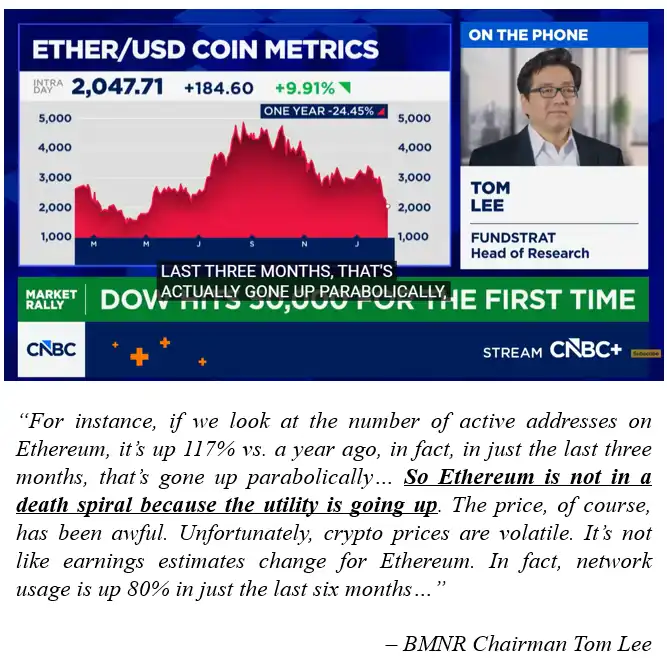
According to Tom Lee's own logic, if Ethereum's on-chain activity does not actually reflect real growth in usage and fundamental improvement, then ETH is indeed in a death spiral.
Our research indicates that this is exactly what is happening.
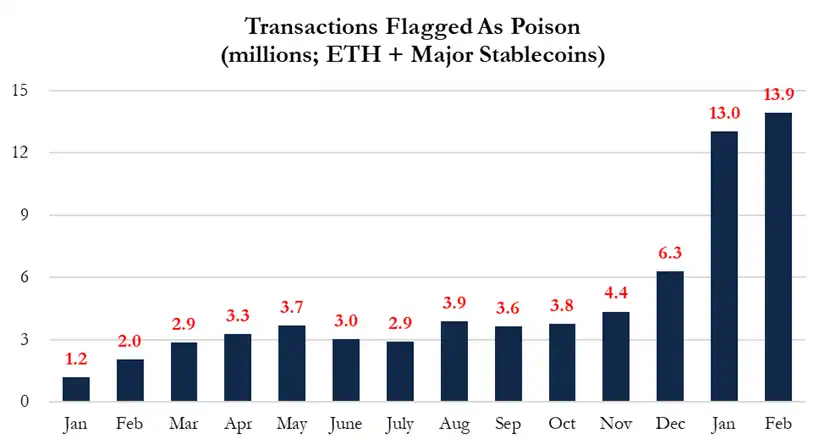
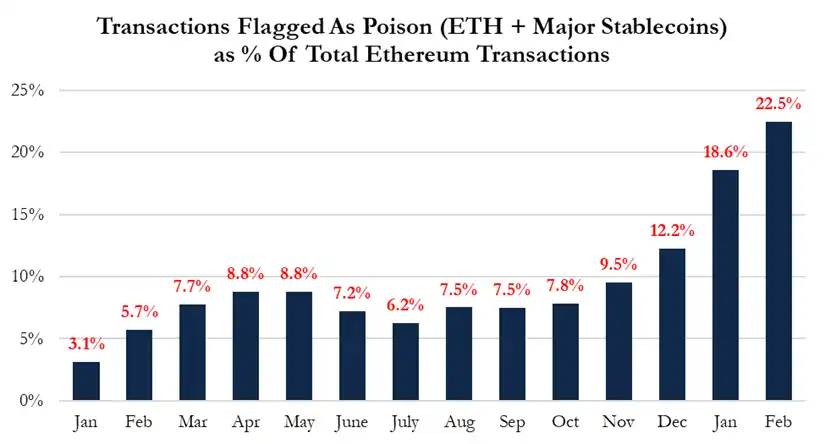
We conducted a comprehensive analysis of on-chain data from January 2025 to February 2026, and the results show that what Lee referred to as "institutional adoption driving Ethereum's activity growth" can actually be explained by a significant amount of address poisoning and wallet dusting behavior from low-value addresses. These behaviors were triggered by the Fusaka upgrade-induced block space surplus.
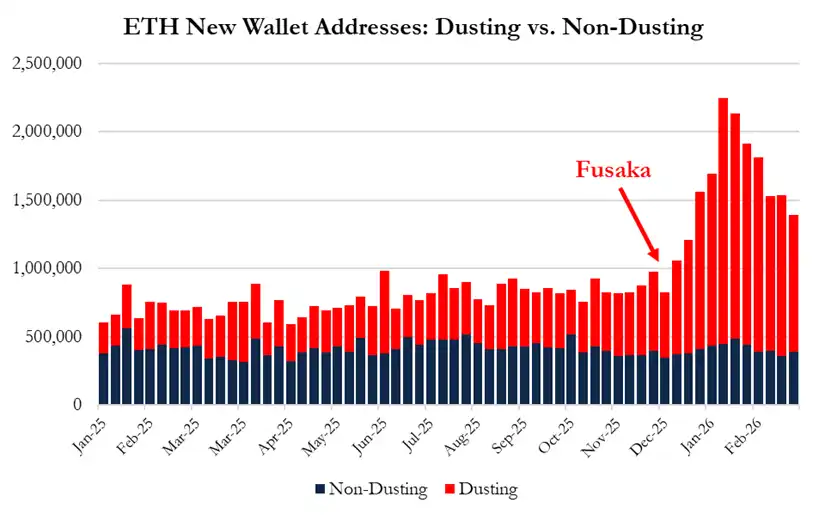
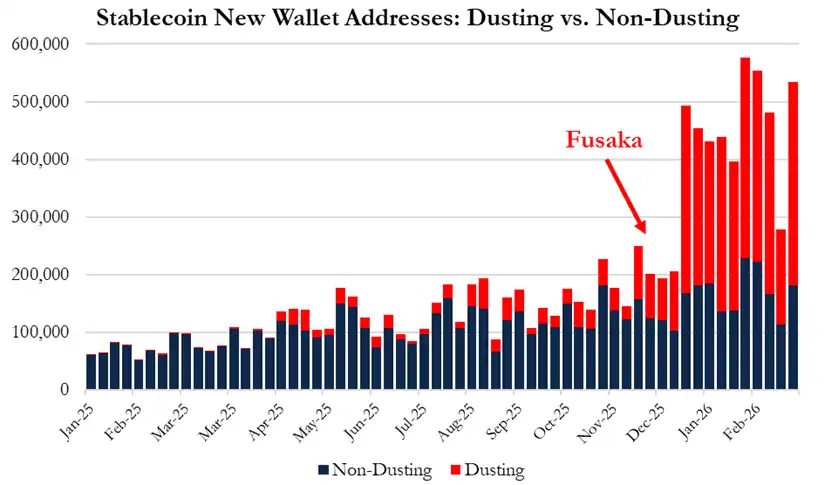
Post-Fusaka Upgrade:
· 95% of new wallet growth is from newly created dust addresses;
· The number of dusting attacks has grown by over 3x;
· Dusting behavior explains over 50% of Ethereum transaction growth;
· Currently, dusting transactions account for 22.5% of all Ethereum transactions;
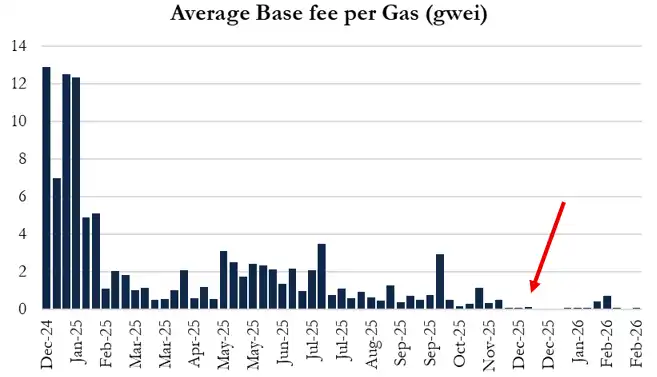
The Fusaka upgrade increased the gas limit from 45M to 60M to expand Ethereum's Layer1 capacity. Vitalik and the protocol team had previously anticipated a 10%-30% reduction in gas fees, but the actual reduction has been around 90%.


Vitalik and validators severely miscalculated the elasticity of demand on Layer1. They relied on outdated mathematical models (based on assumptions pre-EIP-1559 and pre-Layer2) and overestimated Layer1 demand by 3 to 9 times. This is also why we believe Vitalik is selling a significant amount of ETH. On January 30, Vitalik pre-announced a sale of 16,384 ETH to fund the Ethereum Foundation's "austerity period," but since then, he has sold over 19,300 ETH and continues to do so.
Vitalik Understands What Tom Lee Doesn't — ETH's Tokenomics Have Been Broken
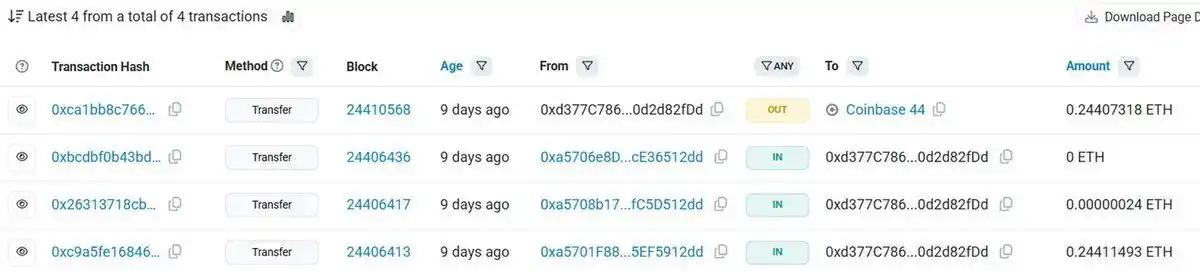
We personally documented the Ethereum network address poisoning phenomenon. We created two new addresses and sent a transaction between them. Within 5 minutes, we were already under an address poisoning attack. We encourage readers to verify this phenomenon themselves. Currently, the speed of losses due to address poisoning has increased by over 8x since the Fusaka upgrade.
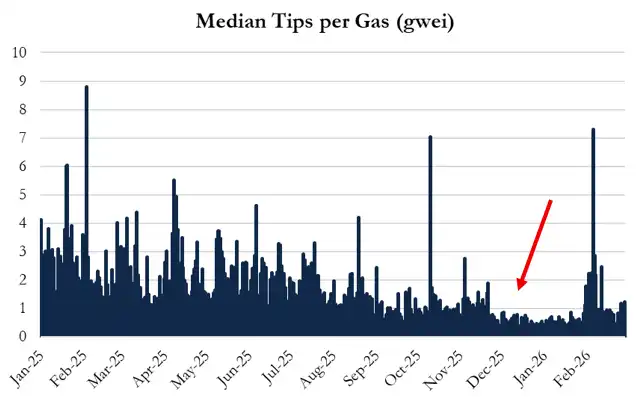
Furthermore, the increase in gas limit has also impacted Ethereum's validator community, with validators now experiencing a 40%–50% decrease in fee income per gas unit. The reduced yield will weaken staking demand and high-value transaction activity, further undermining institutional adoption. This negative feedback loop has now started to spin in reverse.
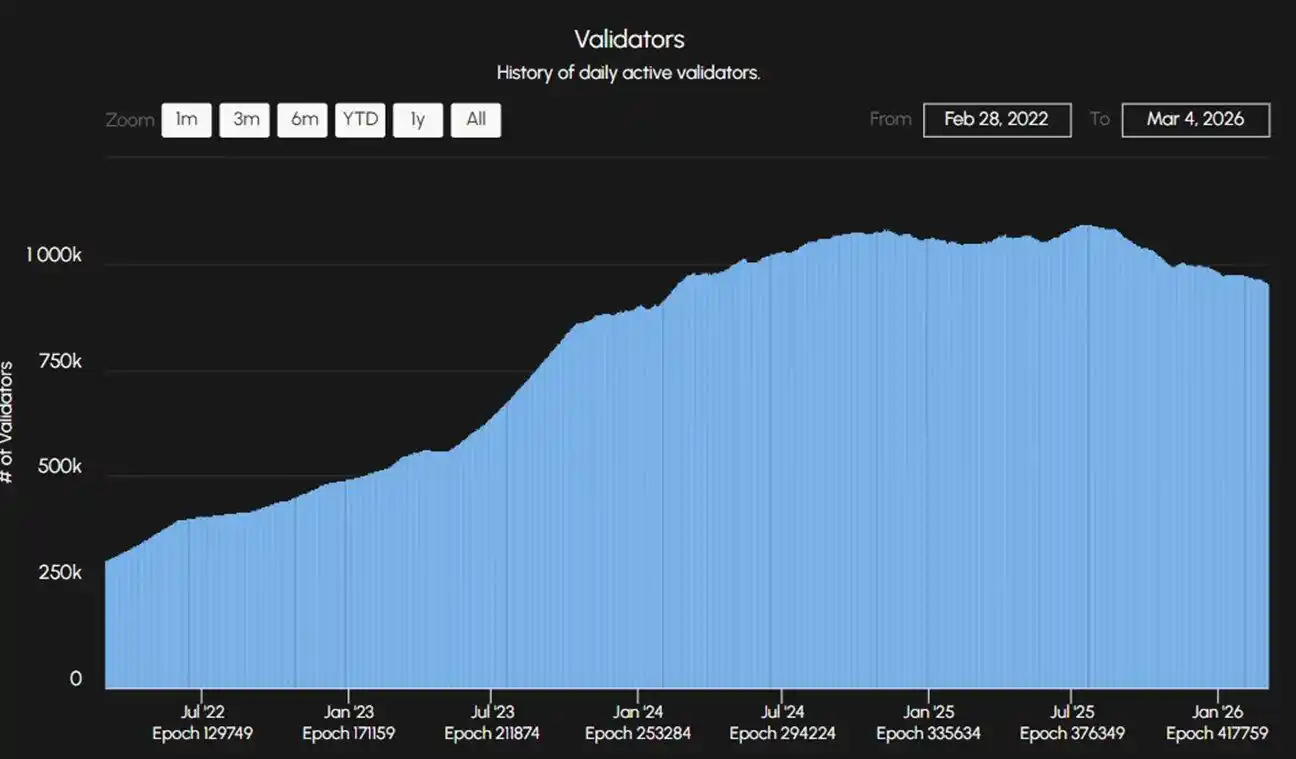
Meanwhile, Ethereum continues to steadily lose market share to Solana and its own Layer 2 networks.
· Solana developer count grew by 29% in 2025;
· Ethereum developer growth was only 6%;
· Talent is leaving the Ethereum ecosystem;
· Institutions like Visa and Citigroup are opting for Solana in DeFi applications;
· Solana DEX trading volume has already surpassed Ethereum's by 2x.
During the Internet bubble era, Netscape and Nokia once dominated the market for over 10 years, but the real winners in the end were Google and Apple. We believe Ethereum is in a similar situation — we believe Ethereum's tokenomics have already collapsed, Tom Lee is stuck in his own position, and ETH's price will continue to decline.
You may also like

Mining Exodus: Someone Holds $12.8 Billion AI Order

March 6 Market Key Intelligence, How Much Did You Miss?

a16z: The True Opportunity of Stablecoins is in Complementing, Not Disrupting

Predict LALIGA Matches, Shoot Daily & Win BTC, USDT and WXT on WEEX
The WEEX × LALIGA campaign brought together football excitement and crypto participation through a dynamic interactive experience. During the event, users predicted matches, completed trading tasks, and took daily shots to compete for rewards including BTC, USDT, WXT, and exclusive prizes.

Ray Dalio Dialogue: Why I'm Betting on Gold and Not Bitcoin

Who Took the Money in the AI Era? A Must-See Investment Checklist for HALO Asset Trading

Pump.fun Hacker Steals $2 Million, Receives 6-Year Prison Sentence, Opts for 'Self-Detonation'

6% Annual Percentage Yield as Musk Declares War on Traditional Banks

36 years, 4 wars, 1 script: How does capital price the world in conflict?

Mining Companies' Great Migration: Some Have Already Secured $12.8 Billion in AI Orders
What Is Vibe Coding? How AI Is Changing Web3 & Crypto Development
What is vibe coding? Learn how AI coding tools are lowering the barrier to Web3 development and enabling anyone to build crypto applications.
The parent company of the New York Stock Exchange strategically invests in OKX: The intentions behind the $25 billion valuation

WEEX P2P update: Country/region restrictions for ad posting
To improve ad security and matching accuracy, WEEX P2P now allows advertisers to restrict who can trade with their ads based on country or region. Advertisers can select preferred counterparty locations for a safer, smoother trading experience.
I. Overview
When publishing P2P ads, advertisers can now set the following:
Allow only counterparties from selected countries or regions to trade with your ads.
With this feature, you can:
Target specific user groups more precisely.Reduce cross-region trading risks.Improve order matching quality.
II. Applicable scenarios
The following are some common scenarios:
Restrict payment methods: Limit orders to users in your country using supported local banks or wallets.Risk control: Avoid trading with users from high-risk regions.Operational strategy: Tailor ads to specific markets.
III. How to get started
On the ad posting page, find "Trading requirements":
Select "Trade with users from selected countries or regions only".Then select the countries or regions to add to the allowlist.Use the search box to quickly find a country or region.Once your settings are complete, submit the ad to apply the restrictions.
When an advertiser enables the "Country/Region Restriction" feature, users who do not meet the criteria will be blocked when placing an order and will see the following prompt:
If you encounter this issue when placing an order as a regular user, try the following solutions.
Choose another ad: Select ads that do not restrict your country/region, or ads that allow users from your location.Show local ads only: Prioritize ads available in the same country as your identity verification.
IV. Benefits
Compared with ads without country/region restrictions, this feature provides the following improvements.
Aspect
Improvement
Trading security
Reduces abnormal orders and fraud risk
Conversion efficiency
Matches ads with more relevant users
Order completion rate
Reduces failures caused by incompatible payment methods
V. FAQ
Q1: Why are some users not able to place orders on my ad?
A1: Their country or region may not be included in your allowlist.
Q2: Can I select multiple countries or regions when setting the restriction?
A2: Yes, multiple selections are supported.
Q3: Can I edit my published ads?
A3: Yes. You can edit your ad in the "My Ads" list. Changes will take effect immediately after saving.

What are the key highlights of this year's Ethereum's most important upgrade, the Glamsterdam upgrade?

March 6 Key Market Update You Can't Miss! | Alpha Morning Report

Sell Nvidia, Buy Power Plant: 27-Year-Old AI Investor Earns $5 Billion in One Year
The $24 Million Heist Behind It: The Most Dangerous Vulnerability in the Crypto World is Actually Human

Justin Sun Lawsuit Dismissed, BlackRock Bullish on Tokenization, What Is the English-Speaking Community Paying Attention To?
Mining Exodus: Someone Holds $12.8 Billion AI Order
March 6 Market Key Intelligence, How Much Did You Miss?
a16z: The True Opportunity of Stablecoins is in Complementing, Not Disrupting
Predict LALIGA Matches, Shoot Daily & Win BTC, USDT and WXT on WEEX
The WEEX × LALIGA campaign brought together football excitement and crypto participation through a dynamic interactive experience. During the event, users predicted matches, completed trading tasks, and took daily shots to compete for rewards including BTC, USDT, WXT, and exclusive prizes.


 App
App