
Paul Atkins Elected as New SEC Chairman, What Lies Ahead for the Future of Crypto?




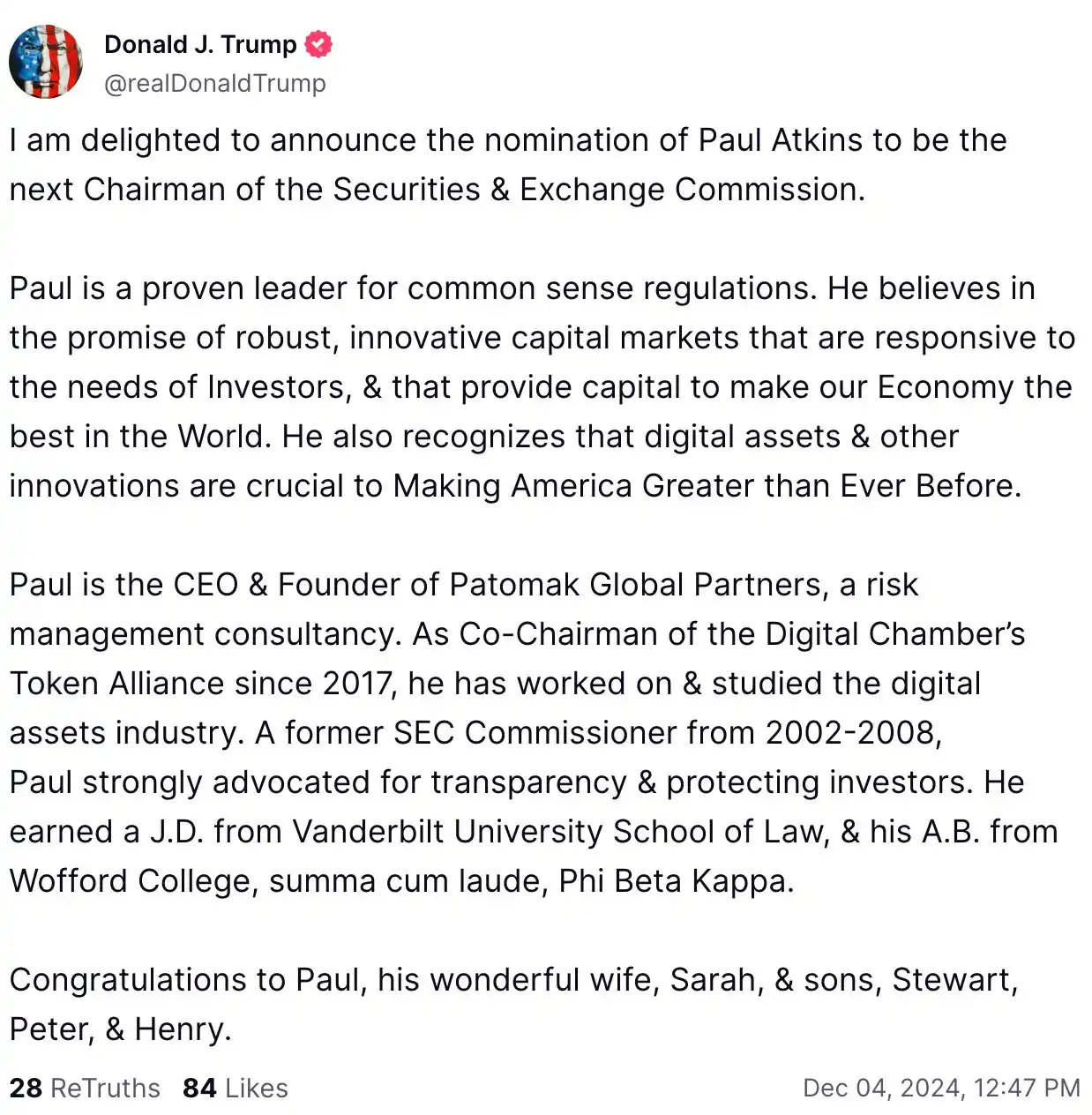
On the early morning of December 5th, Trump announced on Truth Social that Paul Atkins has been confirmed as the Chairman of the U.S. Securities and Exchange Commission. In his statement, he wrote:
“I am pleased to announce the nomination of Paul Atkins as the next Chairman of the U.S. Securities and Exchange Commission.
Paul is an outstanding leader who advocates for common-sense regulation. He believes that strong and innovative capital markets can meet the needs of investors and provide capital support to drive our economy to be the strongest in the world. He also deeply understands that digital assets and other innovations are crucial to making America even greater.
Paul is the CEO and Founder of Patomak Global Partners, a consulting firm focused on risk management. Since 2017, he has served as Co-Chair of the Chamber of Digital Commerce's Token Alliance, dedicated to researching and advancing the digital asset industry. From 2002 to 2008, he served as a Commissioner of the U.S. Securities and Exchange Commission, during which he strongly advocated for transparency and investor protection. He holds a J.D. from Vanderbilt University Law School and an A.B. from Wofford College, graduating with highest honors and is a member of Phi Beta Kappa.”
Congratulations to Paul and his beautiful wife Sarah and their sons Stewart, Peter, and Henry.
Who is Paul Atkins?
Paul Atkins is a former SEC Commissioner during the George W. Bush administration, known for his opposition to imposing significant fines on companies violating securities laws. He previously opposed the Dodd-Frank Act, which aimed to strengthen federal regulatory powers after the 2008 financial crisis.
In 2016, Atkins played a key role in Trump's presidential transition team, influencing Trump's laissez-faire approach to financial regulation.
Currently, Atkins still serves at his consulting firm, Patomak Global Partners, founded in 2009. Since 2017, he has also been serving as Co-Chair of the Token Alliance, an industry association advocating for digital assets and the blockchain industry.
After Trump announced Paul's election as SEC Chairman, RSR experienced a short-term surge of 27%, with the price currently at $0.0231.
The reason for the association with RSR is that the community discovered Atkins had served as an advisor to the project.
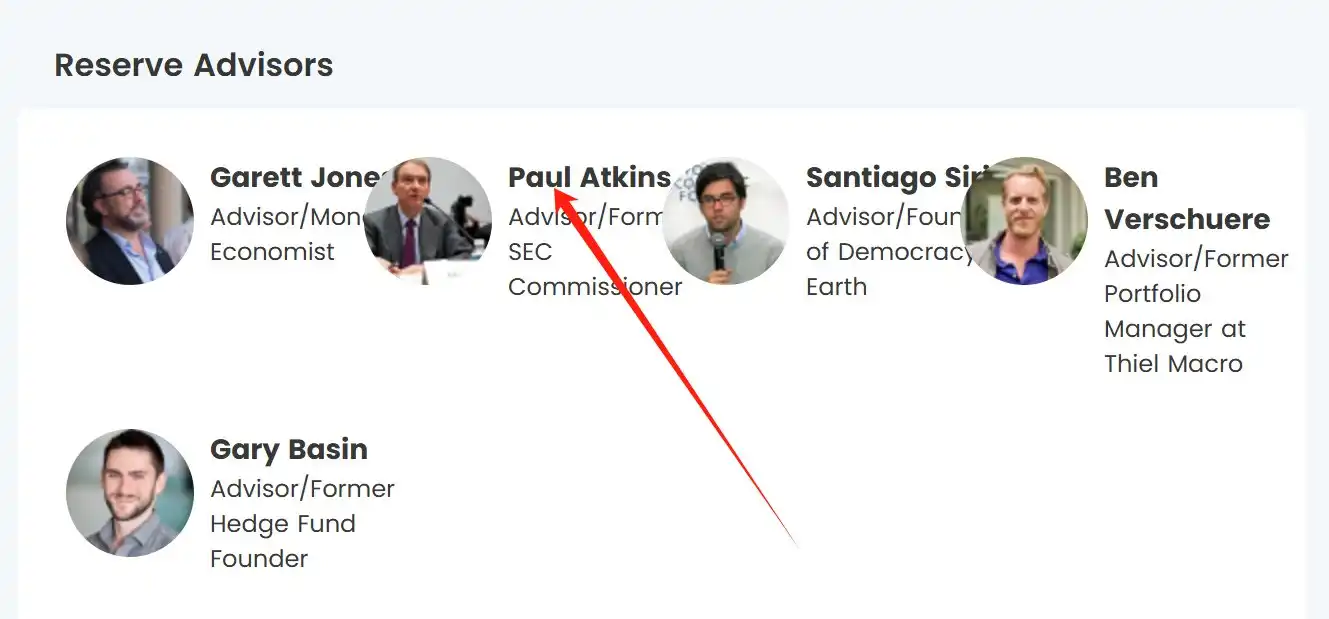
Meanwhile, Reserve founder Nevin Freeman previously explained, "Paul is not currently actively involved in advising Reserve. He was an early advisor to the project. However, in our interactions, his open-mindedness impressed me, and his willingness to publicly serve as a Reserve advisor indicates his commitment to and support of the cryptocurrency space."
What are some SEC Chairman Pump and Dump Concepts
RSR
Reserve Rights (RSR) is a dual-token stablecoin platform launched on the Huobi Prime platform in May 2019. Reserve aims to establish a stable, decentralized stablecoin and digital payment system, with stablecoins that have a self-adjusting supply pegged to demand and feature 100% or more on-chain collateralization.
The main issue that RSR attempts to address is volatility because cryptocurrency volatility limits the market's expansion as a medium of exchange. Due to concerns about potentially losing profits during market downturns, merchants have been reluctant to accept cryptocurrency. The Reserve protocol provides the market with a stable value store, medium of exchange, and deferred payment standard. Today, the focus of the Reserve Rights ecosystem is to help individuals, ministries of finance, and DAOs combat inflation.
RSR has a total supply of 100,000,000,000 tokens, with a current market capitalization of $1,390,407,126 and a TVL of $278,254,588.
DTF
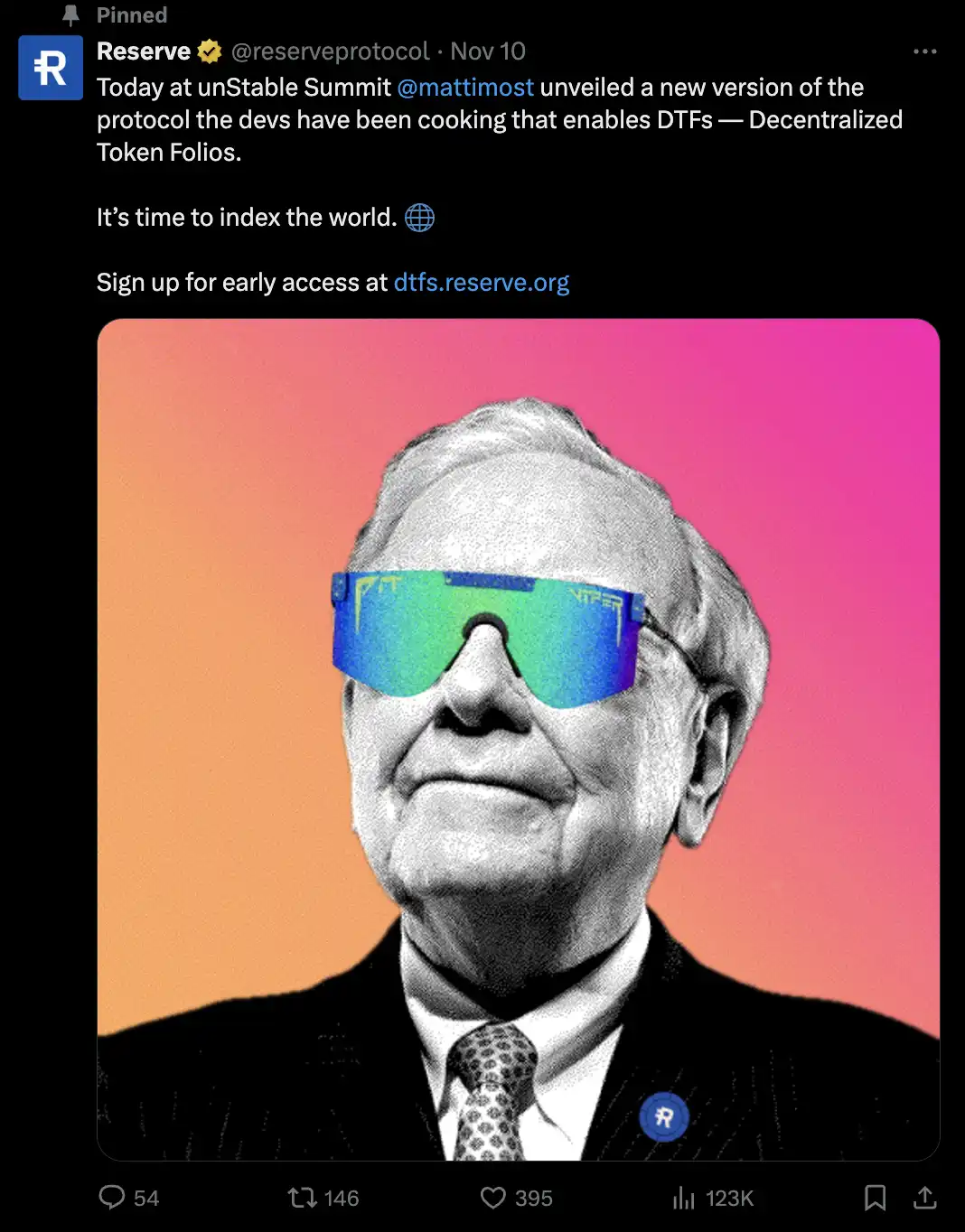
DTF is a meme coin that is not directly related to the Decentralized Token Folios protocol introduced by Reserve. Its full name is "Believe In Something," corresponding to the DTF website's theme "Stop trading, believe in something."
Currently, DTF has a total market value of $23.9 million with a 24-hour trading volume of $20 million.
XRP
XRP Surges Fivefold in a Month, Reclaims Third Place in Crypto Assets by Market Cap, returning to its pre-2020 SEC and Ripple lawsuit levels, making this veteran token one of the strongest performing altcoins recently.
Related Reading: "XRP Returns to Third Place in Crypto Market Cap, What Is Driving Its Surge?"
Ripple is a real-time gross settlement system, currency exchange, and remittance network created by the American technology company Ripple Labs Inc. Ripple was released in 2012, based on an open-source, distributed protocol that supports tokens representing fiat currency, cryptocurrency, commodities, or other value units. It claims to enable "secure, instant, and nearly free global financial transactions of any size, no chargebacks."
With a series of crypto-related policies introduced after Trump took office, XRP's path was significantly influenced by the current SEC chairman's announcement of resignation. In December 2020, the SEC sued Ripple and its two executives—CEO Brad Garlinghouse and co-founder Chris Larsen—alleging that they "conducted an unregistered $1.3 billion securities offering." However, this lawsuit has yet to reach a conclusion.
On December 1, former CFTC Chairman Chris Giancarlo stated in an interview that the SEC should rethink its approach, especially in light of recent legal outcomes and the changing regulatory landscape. When asked if the SEC would drop the lawsuit against Ripple, Giancarlo said, "I think they should... and my bet is that they will."
You may also like

SK Hynix Reportedly Plans U.S. ADR Listing as Early as August, With SEC Approval Possible in Late June
SK Hynix may pursue a U.S. ADR listing as early as August, with SEC approval reportedly possible in late June amid strong AI chip supply chain demand.

SpaceX vs Tesla vs xAI: Which Elon Musk Trade Has the Biggest Upside in 2026?

OpenAI Reveals It Has Confidentially Submitted an S-1 to the SEC, Keeping the Door Open for a Future IPO
On June 9, according to an OpenAI announcement, the company recently confidentially submitted a draft S-1 registration statement to the U.S. Securities and Exchange Commission (SEC), beginning the preliminary compliance process for a potential initial public offering. OpenAI said it chose to disclose this proactively because it expected the news might leak; however, the company has not yet set a specific listing timeline, and related arrangements may still take some time.

Latest research from 13 top universities including Cornell University: The current state, challenges, and misconceptions of the fusion of Crypto and AI
Deconstructing Anthropic: The Best AI Company, Possibly Also a Type of Organizational Invention
Apollo and Blackstone Reportedly Back $35 Billion Anthropic Chip Financing as Deal Details Remain Unclear
On June 9, according to currently available news alerts, Apollo and Blackstone Group participated in a $35 billion financing for an Anthropic “chip project.” Based on the original wording of the report, the funding has already been raised, but public information remains limited. The financing structure, use of proceeds, project entity, and whether Apollo and Blackstone participated through equity, debt, or project financing have not yet been disclosed.

Humanity Protocol Security Incident Escalates: More Than $31 Million Stolen From Related Addresses as Attacker Continues Selling H for ETH
On June 9, according to monitoring by Onchain Lens, more than $31 million has been stolen from addresses linked to Humanity Protocol, and the attack is still ongoing, with the hacker continuously swapping H tokens for ETH. Project founder Terence Kwok later confirmed the security incident on X, saying the issue involved a private key leak.

Bloomberg: As Bitcoin Weakens, Stablecoins and RWA Continue to Drive Expansion in Crypto Businesses
In June, Bloomberg reported that despite Bitcoin falling below $60,000 last week, wiping out about $235 billion in market value within seven days, and dropping close to 50% from last year’s peak, some core businesses in the crypto industry are still expanding, mainly in stablecoins, real-world asset tokenization (RWA), payments, and infrastructure. The report also noted that overall altcoin activity has contracted significantly: altcoin market capitalization has fallen from a peak of about $431 billion in November 2021 to around $170 billion, and among the tens of millions of tokens issued in recent years, fewer than 1,700 still maintain meaningful trading activity.

Galaxy Deep Research Report: How Hyperliquid's HIP-4 Upgrade Changes the Landscape of Prediction Markets?
Binance Research: RWA Market Expected to Expand Nearly 6x from Early 2025, with Public Equities and Onchain Payments Heating Up Together
In June, Binance Research said in its monthly market report that the real-world asset (RWA) market is expected to grow by about 589% from the beginning of 2025. Bond- and money market fund-related RWA expanded by about $6.5 billion, up 83% year over year, while publicly traded equity RWAs grew by about 422%. The report also noted that monthly crypto debit card transaction volume exceeded $747 million in May, up 48.6% year to date.

Japan to Assess a Framework for Yen Stablecoins and Crypto ETFs as Asia’s Compliant Payments Narrative Heats Up
Recently, according to the original report, Japan is considering the launch of yen stablecoins and cryptocurrency ETFs. Public information remains limited at this stage, and there is still no complete policy text, regulatory draft, or clear implementation timeline, so this is better characterized as a “policy discussion” rather than formal implementation. The original wording also noted that advancing stablecoin regulation in Asia is driving XRP usage and supporting growth in the XRPL ecosystem. However, based on currently available public information, there is not enough evidence to directly establish a clear causal relationship between this round of discussion in Japan and XRP or XRPL.

ZachXBT: Humanity private key leak and abnormal surge in H token should be viewed separately
On June 9, according to related disclosures, on-chain investigator ZachXBT posted an update on Humanity’s roughly $31 million security incident, saying that after further analyzing fund flows, he currently tends to believe the project team was not involved in an “inside job” or a self-staged attack. According to him, the official explanation about the private key leak was broadly accurate, but before the token unlock, the price of H had been artificially pushed higher, and the hacker later took advantage of that market environment; therefore, the private key leak and the earlier abnormal price pumping should be regarded as two separate and independent events. This reframing has shifted the market’s understanding of the nature of the incident. Earlier discussion around Humanity had focused on whether the team directly participated in the attack or used the security incident to cover up internal operations. ZachXBT’s latest remarks shift the focus from “whether it was self-theft” to “whether there were pre-unlock market structure issues.” He also questioned whether the team may have.

Morning Report | OpenAI has submitted an S-1 registration statement draft to the U.S. SEC; Morpho completes $175 million financing

Morning Report | BitMine increased its holdings by 126,971 ETH last week; trader Eugene announced his exit from the crypto market

Wang Chuan: How can one not feel anxious after the neighbor Old Wang made thirty times profit by investing in storage stocks? (Seven) - A quarter-century cycle
Cryptocurrency CEXs are flocking to sell US stocks, and traditional brokerages are facing an "uninvited guest."
$75 billion in foreign capital has fled, and South Korean retail investors have absorbed it all using leverage

Japan’s Three Megabanks Plan Joint Stablecoin Issuance in Fiscal 2026
MUFG, SMBC, and Mizuho reportedly plan to jointly issue fiat-pegged stablecoins in fiscal 2026, signaling Japan’s growing push into bank-led digital payment infrastructure.
SK Hynix Reportedly Plans U.S. ADR Listing as Early as August, With SEC Approval Possible in Late June
SK Hynix may pursue a U.S. ADR listing as early as August, with SEC approval reportedly possible in late June amid strong AI chip supply chain demand.
SpaceX vs Tesla vs xAI: Which Elon Musk Trade Has the Biggest Upside in 2026?
OpenAI Reveals It Has Confidentially Submitted an S-1 to the SEC, Keeping the Door Open for a Future IPO
On June 9, according to an OpenAI announcement, the company recently confidentially submitted a draft S-1 registration statement to the U.S. Securities and Exchange Commission (SEC), beginning the preliminary compliance process for a potential initial public offering. OpenAI said it chose to disclose this proactively because it expected the news might leak; however, the company has not yet set a specific listing timeline, and related arrangements may still take some time.
Latest research from 13 top universities including Cornell University: The current state, challenges, and misconceptions of the fusion of Crypto and AI
Deconstructing Anthropic: The Best AI Company, Possibly Also a Type of Organizational Invention
Apollo and Blackstone Reportedly Back $35 Billion Anthropic Chip Financing as Deal Details Remain Unclear
On June 9, according to currently available news alerts, Apollo and Blackstone Group participated in a $35 billion financing for an Anthropic “chip project.” Based on the original wording of the report, the funding has already been raised, but public information remains limited. The financing structure, use of proceeds, project entity, and whether Apollo and Blackstone participated through equity, debt, or project financing have not yet been disclosed.


