
Looking Back at Alpaca Finance: When FUD Turns into a Brief Wealth Code

Original Article Title: "Looking Back at Alpaca: When FUD Becomes a Fleeting Wealth Code"
Original Source: DeepFlow Tech
These days, the soon-to-be delisted "Alpaca Coin" $ALPACA from Binance has been active on the market stage, with a $30 million circulating market value stirring up over $10 billion in total trading volume. On April 24, Binance announced the delisting of four tokens, including Alpaca Finance ($ALPACA), scheduled for May 2.
The news of "Binance delisting" is usually a significant FUD event for a project — delisting implies reduced liquidity, shrinking trading volume, and often a sharp price drop or even collapse for the token.
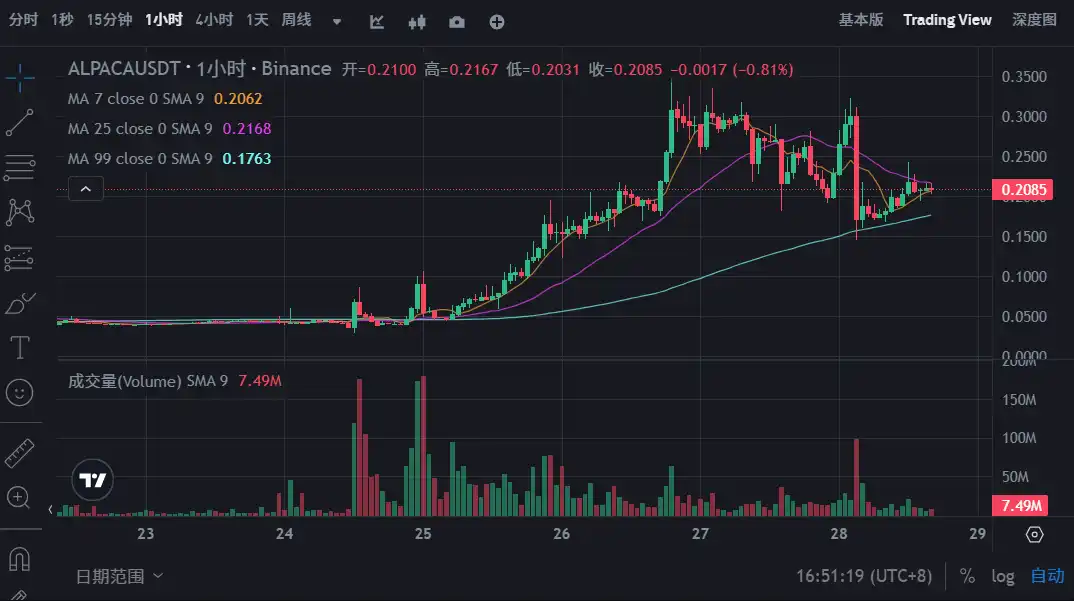
However, after the delisting announcement, $ALPACA experienced a roughly 30% price drop in a short period (based on Binance spot trading), but then the price surged nearly 12x in three days, skyrocketing from $0.029 to a peak of $0.3477. Simultaneously, the open interest (OI) of $ALPACA futures contracts far exceeded its token market value multiple times, ushering in a brutal long vs. short battle around $ALPACA.
Fee Settlement Acceleration Intensifies Long vs. Short Battle
Subsequently, Binance adjusted the funding rate rules, shortening the maximum fee rate settlement period to every hourly (up to 2%), further intensifying the fierce long vs. short battle. Longs not only profited from driving up the price but also continued to "eat" the high funding rate. Longs kept "eating and holding" for several days, leading $ALPACA's price to engage in a high-stakes battle at elevated levels for almost four days.
With an hourly settlement and a -2% fee rate, under the premise of 1x leverage, a short position held for a day would lose at least 48% of the principal. Despite bearing such a high rate, there were still funds willing to continue shorting.
In the intense battle, some noticed that large-scale follow traders with million-dollar positions had been consistently shorting $ALPACA with high leverage, eventually leading to liquidations involving hundreds of millions of dollars of user funds.
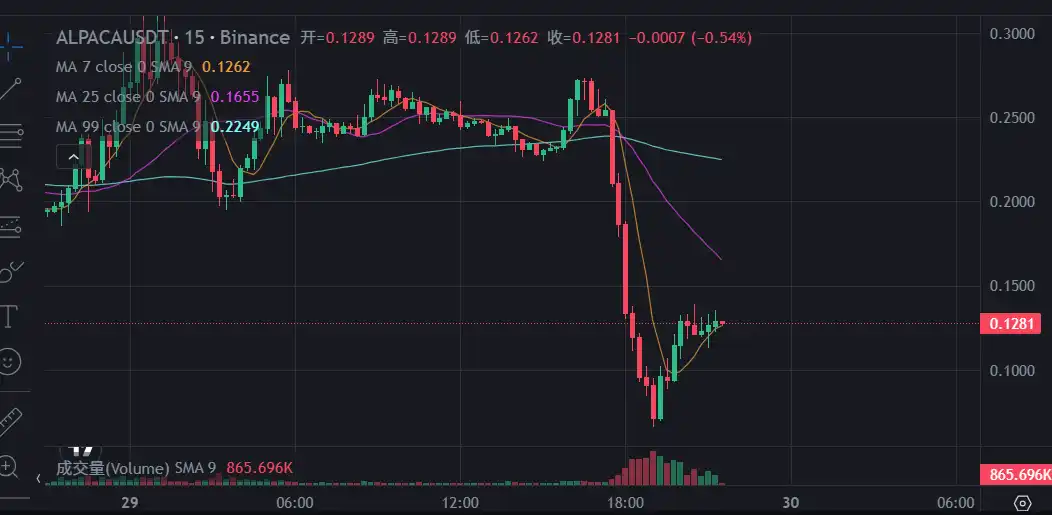
On April 29, Binance raised the $ALPACA contract rate limit to ±4%. For shorts, another increase in the fee rate limit would exponentially raise the cost of shorting. However, despite the rule change that should have discouraged shorts, the price of $ALPACA "counterintuitively" plummeted from $0.27 to around $0.067.
No Absolute Trading Rule
As the trading volume and attention gradually shift, the $ALPACA story may have come to an end.
Looking back at this billion-dollar-scale farce, in some ways, $ALPACA these days can be seen as a kind of meme—brought a massive amount of attention by the delisting bearish news, allowing the "red is also red" principle to be fully leveraged in price fluctuations. At the same time, with a relatively low circulating market cap at the same level of environment (top-tier trading platforms) (bottoming out at less than $4 million), highly controlled chip holdings, and continuously stimulating player's nerves with high volatility price swings, even the image of a "alpaca" can be associated with a meme.
Although the image is cute, for users truly involved in the game, these days can perhaps only be described as "bloody." The appearance of crazy bullish moves on bearish news, and the smooth fall on the news of the "explosion," $ALPACA's complex recent trend has overturned the usual "sell the news" logic and has also overturned many people's positions.
Evidently, the boundary between "good news" and "bad news" has gradually blurred, and the previous single judgment logic has gradually become inapplicable to the constantly evolving market. In its place is the violent manipulation of human nature dominating, with ever-refreshing liquidation data gradually taking over the market. Describing this evolutionary direction as "barbaric growth" may be more appropriate.
However, everything has two sides, and as some feel confused, others feel excited. This farce is not a bad thing for everyone. For many participants who are pursuing price volatility excitement and have outstanding abilities, the alpaca's recent behavior is even a rare opportunity to make a big profit.
There are also voices suggesting that behind the market makers shorting at all costs with copy trading user funds is a hunt for retail investors' funds, as the movie tagline says, "The aristocrat's money is all returned, and the commoners' money is split 70/30." The truth of the statement is hard to judge at the moment, but what can be confirmed is that even if the actual situation is not as dark, the ultimate winner in this manipulation will not be the average user.
In the absence of adequate regulatory measures, $ALPACA may not be the last time this market sees a crazy manipulation. As of the completion of this article, $ALPACA's price is still experiencing intense fluctuations, and perhaps there will be more exciting "performances" before the official delisting.
However, in the precarious price game, there is hardly a safe haven for uninformed participants. Under the hunt of attention and liquidity, perhaps less watching and more action is the retail investor's most positive expected value (EV) move. Those who see major news and abnormal price movements and think, "the opportunity has come," are not just retail investors but also the long-awaiting project teams.

You may also like

Dialogue with AEON co-founder Leo: The real bottleneck of the Agentic Economy is not the model, but the settlement

DeFi has reached its most dangerous moment: the real vulnerabilities are not in the code

Who can make money in the era of Agents?

From brokerages to banks, Hong Kong intensifies efforts to clean up cross-border investment account openings

The trillion-dollar frenzy of selling memory, profits from buying memory are halved

2 years, 225 times the return? Unveiling the mysterious researcher Serenity's AI "bottleneck" investment technique
B.AI partners with BNB Chain to launch the "Billion AI Token Subsidy" celebration, fully igniting the on-chain intelligent agent ecosystem

How did Micron win a trillion-dollar market value while Samsung relies on technology cycles and Hynix relies on HBM?

Senior Public Company Financial Audit: Taking Hashkey as an Example, Discussing Which Account to Include for Exchange Issued Platform Tokens?

Bankless Founder: Why I Sold All My ETH
Morning News | Hyperliquid launches off-chain event prediction market contracts; Strategy completes $1.5 billion debt buyback; Kelp DAO announces rsETH has fully recovered

Morning Report | Binance launches DYOR research tool; YZi Labs launches recruitment platform YZi Talent; Vitalik states that the Ethereum Foundation will "downsize" and reduce the amount of ETH sold

Insiders betting on Musk are reaping "historic returns."
Ten Thousand Characters Breakdown of On-Chain Vaults: Eight Major Tracks, Who is Rising and Who is Declining?

Behind NEAR's Doubling: 3 Major Trends Becoming the Engine of Coin Prices

Visa and Stripe are both working on stablecoins, but their focus is not on payments

How Traders Keep Profits When PEPE WLD and FET Start Moving Fast Again

It's easy to conquer a city, but difficult to govern it: Polymarket wants to establish a presence globally but still has to bow down everywhere
Dialogue with AEON co-founder Leo: The real bottleneck of the Agentic Economy is not the model, but the settlement
DeFi has reached its most dangerous moment: the real vulnerabilities are not in the code
Who can make money in the era of Agents?
From brokerages to banks, Hong Kong intensifies efforts to clean up cross-border investment account openings
The trillion-dollar frenzy of selling memory, profits from buying memory are halved
2 years, 225 times the return? Unveiling the mysterious researcher Serenity's AI "bottleneck" investment technique