
- Buy Crypto
- Markets
 Futures
- Spot
- Copy Trade
- Earn
- More
In the DeFi Buyback Wave: Uniswap, Lido Caught in "Centralization" Controversy

Original Article Title: Uniswap, Lido, Aave?! How DeFi Is Quietly Becoming More Centralized
Original Article Author: Oluwapelumi Adejumo
Original Article Translation: Saoirse, Foresight News
On November 10, when Uniswap's management submitted the "UNIfication" proposal, the document read more like a corporate restructuring than a protocol update.
The proposal plans to activate previously unused protocol fees, route funds through a new on-chain treasury engine, and utilize the proceeds to buy and burn UNI tokens. This model is reminiscent of a stock buyback plan in the traditional finance realm.
A day later, Lido also introduced a similar mechanism. Its decentralized autonomous organization (DAO) proposed to establish an automatic buyback system: when the Ethereum price exceeds $3,000 and the annualized revenue surpasses $40 million, the excess staking rewards will be used to repurchase its governance token LDO.
This mechanism deliberately adopts a "countercyclical" strategy—stronger in bull markets and more conservative in tightening market conditions.
These initiatives collectively signal a major transformation in the DeFi space.
Over the past few years, the DeFi space has been dominated by "Meme tokens" and incentive-driven liquidity activities; now, leading DeFi protocols are repositioning around core market fundamentals such as "revenue, fee capture, capital efficiency."
However, this shift has also forced the industry to face a series of thorny issues: ownership control, ensuring sustainability, and whether "decentralization" is gradually giving way to corporate logic.
The New Financial Logic of DeFi
For much of 2024, DeFi's growth relied mainly on cultural fervor, incentive programs, and liquidity mining. Recent actions such as "reinstating fees" and "implementing a buyback framework" indicate that the industry is attempting to more directly tie token value to business performance.
Take Uniswap, for example, its initiative to "burn up to 100 million UNI tokens" redefines UNI from a pure "governance asset" to an asset that is closer to a "protocol economic interest certificate"—even though it lacks the legal protection or cash flow distribution rights of equity.
The scale of such buyback plans is not to be underestimated. MegaETH Lab researcher BREAD estimates that, at the current fee level, Uniswap could generate approximately $38 million in buyback power per month.
This amount would exceed the buyback rate of Pump.fun but fall below the $95 million monthly buyback scale of Hyperliquid.
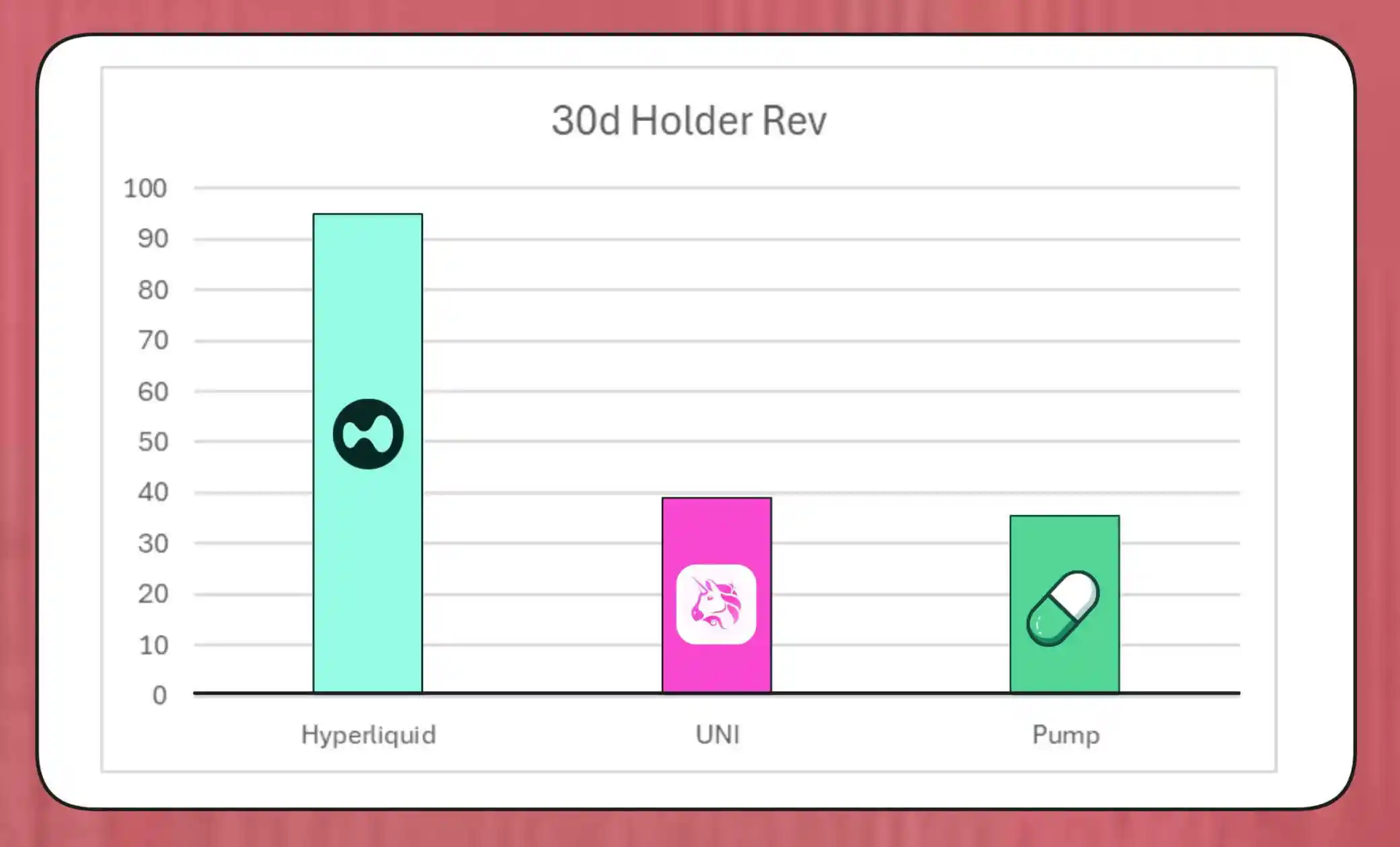
Comparison of Hyperliquid, Uniswap, and Pump.fun Token Buybacks (Source: Bread)
Lido's simulated mechanism structure indicates that it could support a buyback scale of about $10 million per year; the bought-back LDO tokens will be paired with wstETH to be injected into a liquidity pool to enhance trading depth.
Other protocols are also accelerating similar initiatives: Jupiter will allocate 50% of its operational revenue to JUP token buybacks; dYdX will allocate a quarter of the network fees to buybacks and validator incentives; Aave is also devising a specific plan to invest up to $50 million annually, driving buybacks through treasury funds.
According to Keyrock data, token holder dividends linked to revenue have grown over fivefold since 2024. In just the month of July 2025, the total expenditure or allocation on buybacks and incentives by various protocols amounts to approximately $800 million.
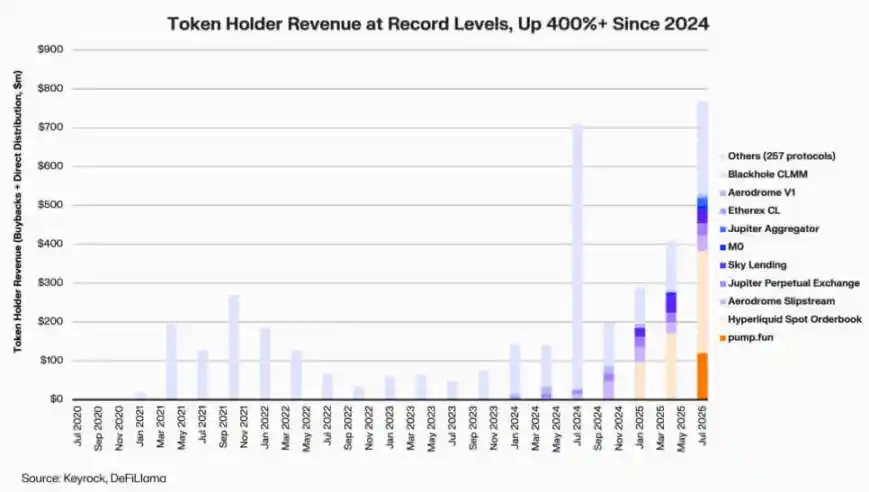
DeFi Protocol Holder Revenue (Source: Keyrock)
Thus, about 64% of the revenue from top protocols now flows back to token holders—a stark contrast to the previous cycle of "reinvestment first, distribution later."
Behind this trend is a new consensus forming in the industry: "scarcity" and "recurring income" are becoming the core of the DeFi value narrative.
Institutionalization of Tokenomics
The buyback wave reflects that the integration of DeFi with institutional finance is deepening.
DeFi protocols are beginning to adopt traditional financial metrics such as "P/E ratio," "yield threshold," and "net distribution rate" to convey value to investors—investors who are also evaluating DeFi projects in the same way they would evaluate a growth-stage enterprise.
This integration has provided fund managers with a common analytical language, but it has also brought new challenges: DeFi's original design did not include institutional requirements such as "discipline" and "transparency," which are now expected by the industry.
It is worth noting that Keyrock's analysis has indicated that many buyback plans heavily rely on existing treasury reserves rather than sustainable recurring cash flows.
This model may be able to temporarily support token prices, but its long-term sustainability is questionable—especially in a market environment where "fee income is cyclical and often linked to token price increases."
Additionally, Blockworks analyst Marc Ajoon believes that "self-initiated buybacks" usually have limited market impact and may result in unrealized losses for the protocol during token price declines.
In light of this, Ajoon advocates for establishing a "data-driven automatic adjustment system": allocate funds when valuations are low, shift towards reinvestment when growth metrics are weak, ensure that buybacks reflect actual operational performance, and not speculative pressure.
He stated: "As it stands now, buybacks are not a panacea... Due to the 'buyback narrative,' the industry blindly places it above other paths that may bring higher returns."
Arca's Chief Investment Officer Jeff Dorman holds a more comprehensive view.
He believes that corporate buybacks reduce the number of outstanding shares, but tokens exist within a unique network—their supply cannot be offset through traditional restructuring or M&A activities.
Therefore, burning tokens can drive protocols towards a "fully distributed system"; however, holding tokens can also reserve flexibility for the future—if demand or growth strategies require, issuance can be increased at any time. This duality makes DeFi's capital allocation decisions more impactful than those in the stock market.
New Risks Emerge
While the financial logic of buybacks is straightforward, its governance implications are complex and far-reaching.
Take Uniswap, for example, where the "UNIfication" proposal plans to transfer operational control from the community foundation to a private entity, Uniswap Labs. This centralization tendency has raised alarms among analysts who believe that this could replicate a "hierarchical structure that decentralized governance was supposed to avoid."
In response to this, DeFi researcher Ignas points out: "The original vision of cryptocurrency 'decentralization' is becoming increasingly challenging."
Ignas emphasizes that over the past few years, this "centralization tendency" has gradually emerged—the most typical example being that DeFi protocols often rely on "emergency shutdowns" or "core team accelerated decisions" when addressing security issues.
In his view, the core issue is this: even if "centralization" makes economic sense, it can still harm transparency and user engagement.
However, proponents argue that this concentration of power may be a "functional necessity" rather than an "ideological choice."
Eddy Lazzarin, Chief Technology Officer at the venture capital firm a16z, described Uniswap's "UNIfication" model as a "closed-loop model" — under this model, the revenue generated by decentralized infrastructure flows directly to token holders.
He further added that the DAO will still retain the power to "mint tokens for future development," thus striking a balance between flexibility and financial discipline.
The tension between "distributed governance" and "execution layer decisions" is not a new issue, but today its financial impact has greatly expanded.
Currently, the treasuries of top protocol managers hold hundreds of millions of dollars, and their strategic decisions can significantly impact the entire liquidity ecosystem. Therefore, as the DeFi economy matures, the focus of governance discussions is shifting from the "decentralization ideal" to the "actual impact on the balance sheet."
DeFi's Maturity Test
The token buyback trend indicates that decentralized finance is transitioning from a "free exploration phase" to a "structured, metrics-driven industry." What once defined this space as "free exploration" is gradually being replaced by "cash flow transparency," "performance accountability," and "investor interest alignment."
However, maturity also brings new risks:
· Governance may lean towards "centralized control";
· Regulators may view buybacks as "actual dividends," sparking compliance disputes;
· Teams may shift focus from "technical innovation" to "financial engineering," neglecting core business development.
The sustainability of this transformation depends on decisions at the execution level:
· The "programmatic buyback model" can embed transparency through on-chain automation, preserving decentralization;
· The "self-initiated buyback framework," although faster to implement, may undermine credibility and legal clarity;
· A "hybrid system" (linking buybacks to measurable, verifiable network metrics) could be a compromise, but there are currently few real-world cases proving its "resilience."
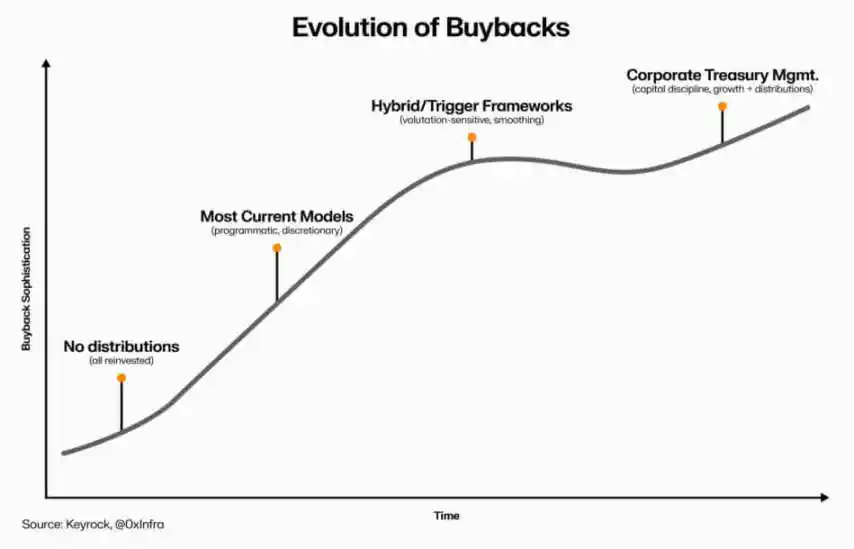
The Evolution of DeFi Token Buybacks (Source: Keyrock)
One thing is clear: the interaction between DeFi and traditional finance has surpassed mere "simple imitation." Today, the sector, while preserving its "open-source foundation," is integrating corporate management principles such as "treasury management," "capital allocation," and "balance sheet prudence."
Token buybacks are a concentrated manifestation of this integration—it combines market dynamics with economic logic, driving DeFi protocols to transform into "self-funded, income-driven organizations": accountable to the community, with "execution effectiveness" rather than "ideology" as the measuring standard.
You may also like

Best Crypto to Buy Now February 10 – XRP, Solana, Dogecoin
Key Takeaways XRP is set to revolutionize cross-border transactions, potentially reaching $5 by the end of Q2 with…

Kyle Samani Criticizes Hyperliquid in Explosive Post-Departure Market Commentary
Key Takeaways: Kyle Samani, former co-founder of Multicoin Capital, publicly criticizes Hyperliquid, labeling it a systemic risk. Samani’s…

Leading AI Claude Forecasts the Price of XRP, Cardano, and Ethereum by the End of 2026
Key Takeaways: XRP’s value is projected to reach $8 by 2026 due to major institutional adoption. Cardano (ADA)…

Bitcoin Price Prediction: Alarming New Research Cautions Millions in BTC at Risk of ‘Quantum Freeze’ – Are You Ready?
Key Takeaways Quantum Threat to Bitcoin: The rise of quantum computing presents a unique security challenge to Bitcoin,…
XRP Price Prediction: Could XRP Ultimately Surpass Bitcoin and Ethereum?
Key Takeaways XRP has maintained a strong position despite a recent 12% drop, suggesting potential for growth. Analyst…

Best Crypto to Buy Now February 6 – XRP, Solana, Bitcoin
Key Takeaways The cryptocurrency market is experiencing pressure due to a technology-sector selloff, affecting digital assets like Bitcoin.…

South Korea Broadens Crypto Market Investigation Following Bithumb’s $44 Billion Bitcoin Error
Key Takeaways South Korea intensifies scrutiny on cryptocurrency exchange operations after Bithumb’s significant Bitcoin transaction error. Regulatory bodies,…
Tom Lee-Supported Bitmine Dominates 3.6% of Ethereum Supply Post-Price Crash
Key Takeaways Bitmine Immersion Technologies now controls 3.6% of Ethereum’s total supply after strategic purchases during market downturns.…

XRP Yearly Returns Hit Record Low Since 2023
Key Takeaways XRP’s yearly returns are at their lowest since 2023, as the crypto market grapples with a…

BTC Traders Eye $50K as Potential Bottom: Key Metrics to Monitor This Week
Key Takeaways Traders are closely monitoring the potential bottom for Bitcoin at $50,000 as recent price movements suggest…

Fraudulent ‘XRP’ Issued Token Sparks Confusion on the XRP Ledger
Key Takeaways An imposter XRP token is causing bewilderment within the XRP community by being superficially identical to…

XRP Yearly Returns Reach Their Lowest Point Since 2023
Key Takeaways XRP’s weakest annual performance since 2023 highlights the ongoing struggles within the cryptocurrency market. Market dynamics…

Cardano ‘Midnight Fixes Everything’: Charles Hoskinson
Key Takeaways Cardano’s Midnight sidechain, launched in December 2025, is championed by Charles Hoskinson as a solution to…

SHIB Army Burns 3,564,772 SHIB, While Half Quadrillion Coins Remain in Circulation
Key Takeaways The Shiba Inu community has collectively burned nearly 3.5 million SHIB tokens recently, yet a substantial…

XRP Ledger Network Activity Decreases by 80% as Institutional Participation Wanes
Key Takeaways: Recent metrics indicate an 80% decline in XRP Ledger network activity, correlating with diminished institutional involvement.…

Michael Saylor Insists “We Will Not Be Selling” As Strategy (MSTR) Stock Breaks Out
Key Takeaways Strategy, formerly MicroStrategy, remains highly sensitive to Bitcoin’s volatile market, with its stock performance closely mirroring…

Brad Garlinghouse Adds Personal Touch to XRP Community Day with Exclusive Merch
Key Takeaways Brad Garlinghouse, CEO of Ripple, has personally signed exclusive merchandise for XRP Community Day, adding excitement…

PIPPIN Price Surge Signals Potential Breakout Despite Investor Selling
Key Takeaways PIPPIN has experienced a significant rally, with its price increasing by 159%, nearing its all-time high.…
Best Crypto to Buy Now February 10 – XRP, Solana, Dogecoin
Key Takeaways XRP is set to revolutionize cross-border transactions, potentially reaching $5 by the end of Q2 with…
Kyle Samani Criticizes Hyperliquid in Explosive Post-Departure Market Commentary
Key Takeaways: Kyle Samani, former co-founder of Multicoin Capital, publicly criticizes Hyperliquid, labeling it a systemic risk. Samani’s…
Leading AI Claude Forecasts the Price of XRP, Cardano, and Ethereum by the End of 2026
Key Takeaways: XRP’s value is projected to reach $8 by 2026 due to major institutional adoption. Cardano (ADA)…
Bitcoin Price Prediction: Alarming New Research Cautions Millions in BTC at Risk of ‘Quantum Freeze’ – Are You Ready?
Key Takeaways Quantum Threat to Bitcoin: The rise of quantum computing presents a unique security challenge to Bitcoin,…
XRP Price Prediction: Could XRP Ultimately Surpass Bitcoin and Ethereum?
Key Takeaways XRP has maintained a strong position despite a recent 12% drop, suggesting potential for growth. Analyst…
Best Crypto to Buy Now February 6 – XRP, Solana, Bitcoin
Key Takeaways The cryptocurrency market is experiencing pressure due to a technology-sector selloff, affecting digital assets like Bitcoin.…


 App
App