
 Buy Crypto
- Markets
 Futures
- Spot
- Copy Trade
- Earn
- More
BTC Price Flash Crash: Are Long-Term Holders Selling the Dip to Fuel the Bull Market?

Original Title: "BTC Flash Crash Needle Insertion, LTH Profit Taking a Bull Market 'Standard'?"
Original Source: BitpushNews
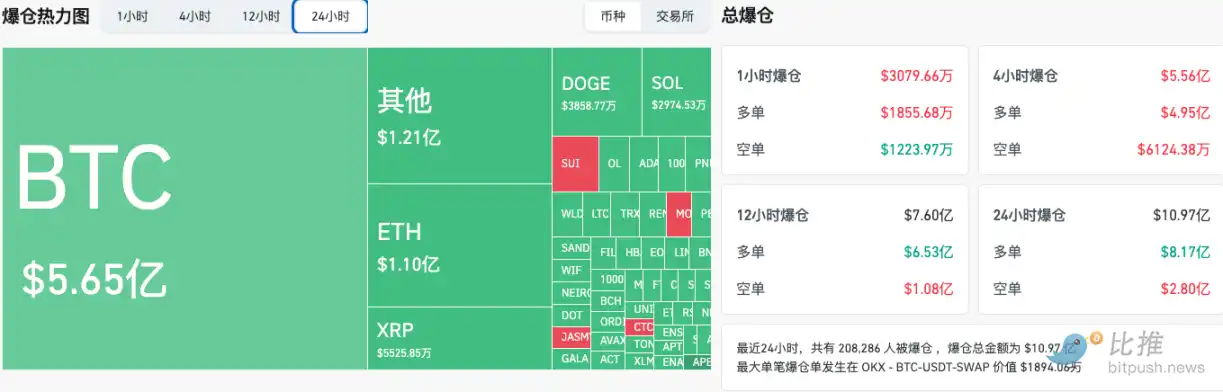
Bitpush data shows that after hitting a historical high of nearly $104,000 yesterday, Bitcoin experienced a sudden and sharp plunge around 6:30 AM Beijing time on December 6, plummeting to around $91,000 in a few minutes, leading to a widespread market liquidation. Data shows that in the past 24 hours, nearly 210,000 investors were liquidated, totaling over $1 billion, with long positions predominating. At the time of writing, the BTC price has rebounded to above $97,000. This needle insertion did not affect other altcoins.
Analyst: LTH Profit Taking Not Yet at Extreme Levels
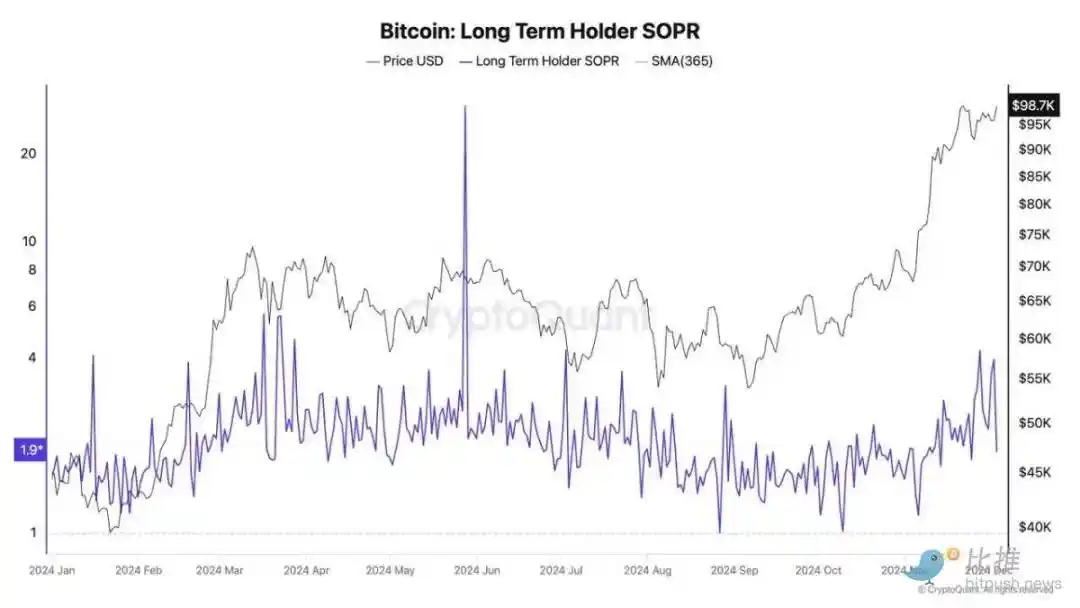
CryptoQuant's data shows that after breaking the $100,000 mark, long-term holders (LTH) began to take profits. The Long-Term Holder Spent Output Profit Ratio (LTH-SOPR) indicator shows that the Bitcoin sold by long-term holders has realized four times the profit from their original purchase price. Julio Moreno, CryptoQuant's research director, pointed out: "After Bitcoin broke the $100,000 mark, long-term Bitcoin holders (LTH) started to take profits, which is a normal phenomenon during a Bitcoin bull market, and profit-taking has not yet reached extreme levels."
However, analysts believe that profit-taking is just one factor leading to Bitcoin's fall. Owen Lau, Executive Director and Senior Analyst at Oberheim, had previously warned investors to be cautious when Bitcoin reached $100,000, as profit-taking scenarios might arise. In addition, market concerns about macroeconomic conditions, regulatory policies, and other factors could also exacerbate market volatility.
Focus on Non-Farm Payrolls Data
Investors are currently focusing on the upcoming release of US non-farm payroll data on December 6 in Eastern Time, as this data could have a significant impact on the Fed's monetary policy, which may in turn affect the Bitcoin market.
Jag Kooner, Derivatives Director at Bitfinex, stated that the market is generally expecting positive trends in November's non-farm payroll data. If the data shows strength, the Fed may slow down its rate cut pace, or even delay rate cuts. This would lead to a stronger US dollar, exerting a certain dampening effect on risk assets, including Bitcoin.
However, the current market still leans towards a rate cut expectation for the Federal Reserve's December meeting. Data from the Chicago Mercantile Exchange shows that the market widely believes the Fed will cut interest rates by 25 basis points in December with a probability of over 70%. Lower rates typically stimulate market liquidity and provide support for risk assets, thus having a positive impact on Bitcoin prices.
In addition to monetary policy factors, institutional investor interest and political sentiment continue to support Bitcoin's rise. WeFi Co-Founder Maksym Sakharov emphasized that institutional investors have been steadily accumulating Bitcoin, with many believing that as global trade prepares for the impact of Donald Trump's proposed tariffs, Bitcoin can serve as a hedge against inflation and economic uncertainty.
Sakharov stated, "Institutional accumulation remains a key driving factor for Bitcoin price momentum. Additionally, the optimistic sentiment surrounding the Trump administration's support for cryptocurrency policies has boosted market confidence, and the combination of institutional purchases and favorable political sentiment has lifted the price of the coin."
21Shares' Cryptocurrency Research Strategist Matt Mena believes that the next key target for BTC is $110,000, as Deribit data shows that most of the call option contract volume on January 31, 2025, is concentrated at that price level.
You may also like

The New Yorker in-depth investigation interpretation: Why do OpenAI insiders consider Altman untrustworthy?
Two Divided Worlds: Insights from the New York Digital Asset Summit, the Most Institutionalized Blockchain Conference

Top Ten Reveals of CZ's New Book: Advance Knowledge of "94", the Inside Story of Huobi's Change of Ownership Made Public for the First Time

Ceasefire Overnight Erases War Premium, Three Fault Lines Only One Sealed | Rewire News Morning Brief

Robinhood Secures 'Trump Account': Enabling Millions of Newborns to Access the Stock Market

Afraid to Open the Pandora's Box? Anthropic's Most Powerful Model Ever Dares Not Be Disclosed

US-Iran Ceasefire: A Temporary Pause or Prelude to Renewed Conflict? Market Outlook for Oil, Gold, and Bitcoin
April 8, 2026 – A temporary ceasefire between the U.S. and Iran has provided some immediate relief to the global markets, but the fundamental question remains: Will the cessation of hostilities hold, or is this merely a brief reprieve before a resumption of conflict? As the situation unfolds, market observers are closely monitoring how key assets like oil, gold, and Bitcoin will react in the coming weeks. This article explores whether the ceasefire is a sign of lasting peace, assesses the short-term market implications, and delves into the evolving role of Bitcoin in the global financial landscape.

WEEX Market Update: U.S.-Iran Ceasefire Sparks Bitcoin Price Surge
April 8, 2026 – In a significant shift in global geopolitics, U.S. President Donald Trump has announced a temporary two-week ceasefire with Iran, resulting in a notable market reaction across various asset classes. This development comes after discussions between Trump, Pakistani Prime Minister Shahbaz Sharif, and Army Chief General Asim Munir. The announcement is already reverberating through markets, particularly in oil, gold, and cryptocurrencies.
Morning Report | South Korean financial institutions pilot stablecoin payments for foreign users; Morgan Stanley Bitcoin ETF is about to be listed; CME plans to launch AVAX and SUI futures contracts

EigenCloud Founder: AI and Cryptocurrency are Creating the Next Trillion-Dollar Asset Class
From Panic to Pumps: How Bitcoin Traders Are Playing the 2-Week US-Iran Ceasefire
For most people, the two-week US-Iran ceasefire is about geopolitics, oil prices, and whether World War III gets postponed. But for crypto traders glued to their screens late Sunday night, it was something else entirely: the clearest risk-on signal in months.

US-Iran Ceasefire Triggers Oil Plunge, Bitcoin Surge, and Gold Rally
Despite the sharp rally, caution is warranted. The $70,000–$72,000 zone has historically been strong resistance. The ceasefire is only temporary (two weeks), and any breakdown in negotiations could trigger a sell-off toward the $62,000–$65,000 support zone. For now, Bitcoin needs to close decisively above $72,500 to confirm a true breakout; failure to do so within 48–72 hours could lead to a swift retracement.

OpenAI has no "New Deal," a blueprint for AI that refuses to pay.

Wall Street Flash Mob Run? Mega-Cap Stock Plunge, Goldman's Great Escape, Illustrated Guide to Private Credit Crisis

OpenAI Feud: Power, Trust, and the Uncontrollable Boundaries of AGI
「AI Doomsday Cult」 Sends Operatives into the Strait of Hormuz: What Did They Find?
Everyone is waiting for the war to end, but is the oil price signaling a prolonged conflict?


 App
App