
 Buy Crypto
- Markets
 Futures
- Spot
- Copy Trade
- Earn
- More
6 Major Global Institutions 2025 Outlook: AI Boom Continues, Key Year for Exploring Alpha

Original Author: Stoic
Original Translation: DeepTech TechFlow
Distill the core views of top global institutions for you, saving you time reading hundreds of pages of reports.
Data Source: J.P. Morgan, Blackrock, Deutsche Wealth, World Bank, Goldman Sachs, and Morgan Stanley.
1. J.P. Morgan's Core Views
· Global Economic Growth: It is expected that global economy will continue to grow by 2025, but China's economy may experience significant slowing.
· Stock Market Forecast: The S&P 500 index is expected to reach 6500 points, but global stock markets may show divergence.
Global Market Outlook
In the coming months, market trends will be influenced by the interaction of macroeconomic trends and monetary policy, while policy changes by the new U.S. administration will also bring uncertainty.
Technological innovation, especially the 'Continuation of the AI Boom,' will be a key driver of the market.
Interest Rate Outlook
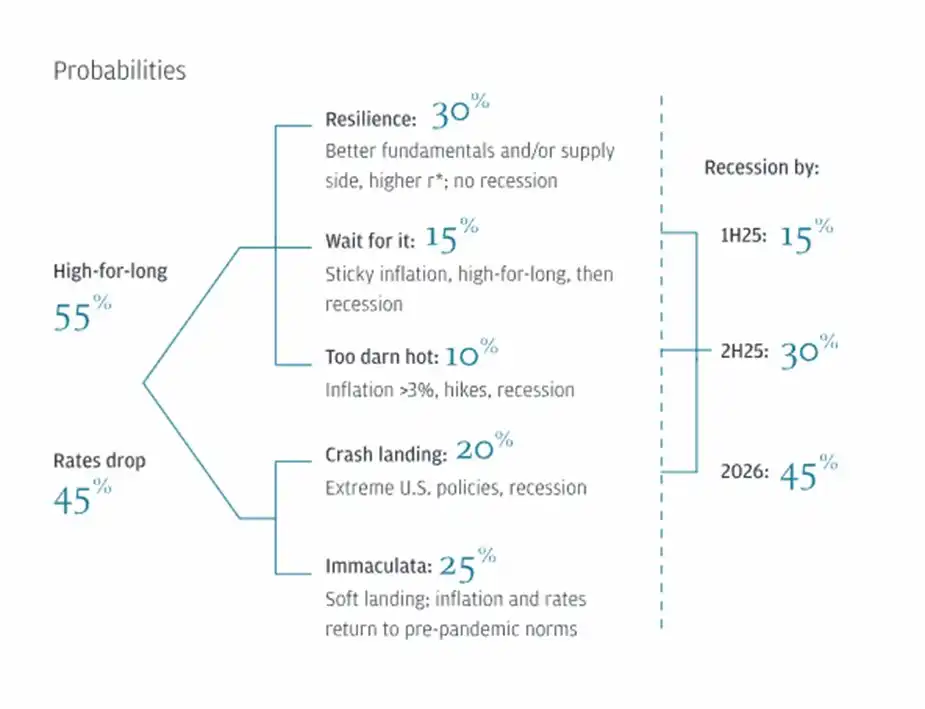
The baseline forecast suggests that global economic growth is resilient, but the persistence of inflation will limit further monetary policy easing in 2025.
However, the new Trump administration may bring risks, such as overly aggressive trade and immigration policies that could impact the supply side and dent global market confidence.
Baseline Scenario Forecast
· Strong global economic growth.
· Positive outlook for U.S. stocks and gold, but the prospects for oil and base metals are not optimistic.
2. Blackrock's Core Views
· Unique Market Environment: The current market is in a unique phase, where long-term assets exhibit unusually strong reactions to short-term events.
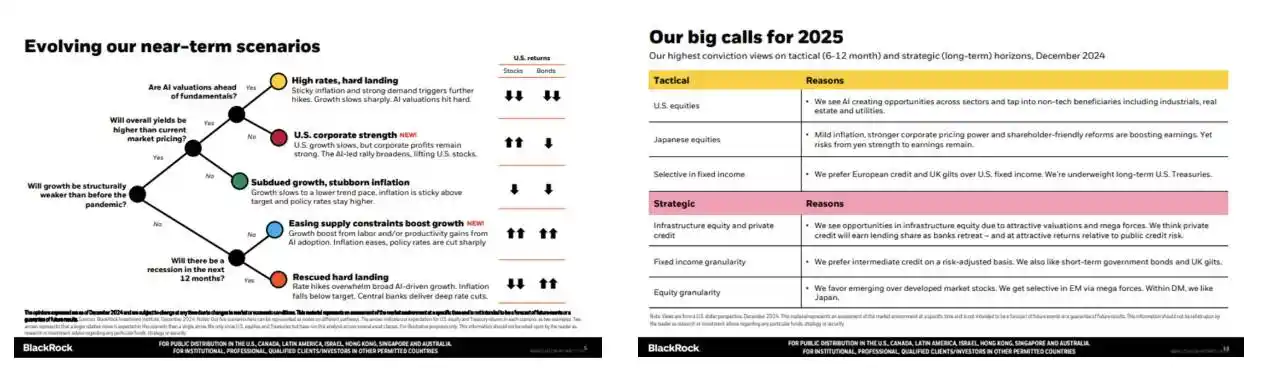
· Investment Strategy: Bullish on risk assets, further overweighting U.S. stocks as the 'AI theme is rapidly expanding'.
· Inflation and Interest Rates: It is expected that inflation and interest rates will remain at levels higher than pre-pandemic.
2025 Market Outlook
· Inflation Pressure: Due to intensified geopolitical divisions and accelerated spending on "AI infrastructure development and low-carbon transformation," inflation pressure is expected to persist.
· Fed Policy: The Fed is unlikely to significantly cut interest rates, and rates are not expected to drop below 4%.
· Long-Term Bond Yields: Given budget deficits, sticky inflation, and increased market volatility, investors may require a higher risk premium, leading to a rise in long-term government bond yields.
Key Investment Themes
· AI-Driven Investment Craze: The AI race will continue to drive market investments.
· U.S. Stocks to Continue Outperforming: U.S. stocks are expected to continue their strong performance, but investors need to be flexible in response to market changes.
· Monitoring Risk Signals: Signals such as a surge in long-term bond yields or escalated trade protectionism could be key triggers for adjusting investment strategies.
3. Deutsche Wealth's Core Views
In a backdrop of an "economically challenging environment," inflation may remain high due to "increased fiscal spending and potential tariff hikes."
"This will limit central banks' room to stimulate the economy through rate cuts, forcing them to seek a balance between growth and inflation control. This uncertainty could alter market expectations and trigger more volatility than in 2024. Additionally, geopolitical conflicts triggered by changes in trade policies could further exacerbate market instability."
Asset Allocation Themes
· The U.S. economy may achieve a soft landing, with steady economic growth and robust investment.
· Focus on growth stocks, but be cautious of high volatility risks.
· Corporate profit growth and large-scale stock buybacks will benefit the U.S. stock market.
Investment Advice:
- Focus on the long-term positive trend of economic growth.
- Consider adopting a diversified investment portfolio and actively manage risks.
Key Points Overview
· Despite geopolitical tensions and high interest rates, global economic growth is expected to edge up from 2.6% in 2024 to 2.7% in 2025-26.
· While short-term growth prospects have improved, the growth of most economies globally remains below the average level of the 2010s.
· Global inflation is expected to slowly decline, averaging 3.5% in 2025. Central banks may remain cautious in their accommodative policies.
· Risks such as geopolitical conflicts and climate disasters continue to exist, with a greater impact on vulnerable economies.
· Policy recommendations include supporting green and digital transformation, promoting debt relief, and enhancing food security.
4. World Bank Group 2025 Outlook Highlights
· Despite facing challenges from geopolitical tensions and high interest rates, global economic growth is expected to remain at 2.6% in 2024. By 2025-2026, with a gradual recovery in trade and investment, this growth rate may slightly increase to 2.7%.
· While short-term growth prospects have improved, overall performance remains weak. During 2024-2025, nearly 60% of the world's economies are projected to grow at rates lower than the average level of the 2010s, accounting for over 80% of global output and population.
· The global inflation easing is expected to be slower than previously anticipated, with an average inflation rate of 3.5% this year. Due to lingering inflationary pressures, central banks may exercise more caution in easing monetary policies.
· Recent multiple shocks have caused many emerging markets and developing economies to stagnate in catching up with advanced economies. Data shows that nearly half of EMDEs underperformed compared to advanced economies during 2020-2024. The future prospects are even bleaker for those fragile economies heavily impacted by conflicts.
· Despite a somewhat balanced risk picture, downside risks still dominate overall. Key risks include:
- Continued geopolitical tensions.
- Further global trade fragmentation.
- Sustained high interest rates coupled with persistent inflationary pressures.
-Frequent occurrence of natural disasters related to climate change.
· To address the above challenge, global policies need to focus on the following aspects:
-Maintaining the stability of the international trade system.
-Promoting green and digital transformation to support economic sustainability.
-Providing debt relief support to help alleviate the pressure on highly indebted countries.
-Improving food security issues, especially in fragile economies.
· For emerging markets and developing economies, high debt and its servicing costs pose a severe challenge. These countries need to find a balance between meeting significant investment needs and maintaining fiscal sustainability.
· To achieve long-term economic and social development goals, countries need to take the following policy measures:
-Increase productivity growth to drive economic efficiency.
-Improve the efficiency of public investments to ensure proper fund utilization.
-Enhance human capital development, such as education and skills training.
-Narrow the gender gap in the labor market and increase female labor force participation.
5. Goldman Sachs Key Insights
「2025: The Key Year for Exploring Excess Returns」
· The simultaneous occurrence of interest rate declines and economic growth may favor the stock market.
· Current stock valuations are nearing highs, and future earnings growth will be a key driver of the market.
· Since October 2023, global stock markets have risen by 40%, making the market more susceptible to negative news.
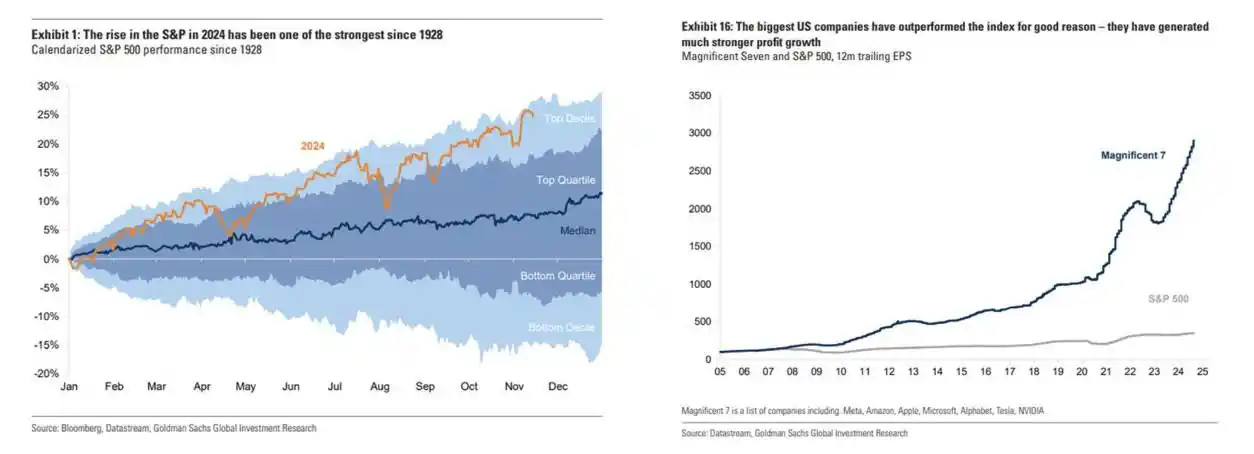
· The S&P 500 index has had one of the strongest rallies since 1928, with the Nasdaq index rising over 50%, and NVIDIA seeing a surge of up to 264%. This trend is mainly driven by expectations of "peak inflation" and a "shift in Fed policy."
· The increase in price-to-earnings ratios has brought stock and credit valuations to historic highs, especially with the performance in European and Chinese markets nearing long-term average levels, no longer in undervalued territory.
· Although stock valuations are high, this does not completely suppress the possibility of further upside. However, high valuations may exert some pressure on future returns.
· Large US tech companies have performed well, primarily benefiting from strong profit growth. Their valuation levels reflect their solid fundamentals rather than market hype.
Risk Analysis
The report mentions two key risks:
1. The recent optimism in the market has already priced in some of the future returns, making the market more vulnerable to correction.
2. There are still many unknown factors regarding tariff risks, which may introduce uncertainty.
Goldman Sachs emphasizes the strategy of "diversifying investments and achieving alpha" to address these risks.
The specific strategies include:
· Broadening the investment scope to include more asset classes;
· Seeking potential value investment opportunities;
· Achieving geographical investment diversification to mitigate risks.
6. Market Outlook from Morgan Stanley
Key Themes
1. High Market Valuations Morgan Stanley believes that current market valuations are generally high, and most investors no longer see asset prices as cheap. Therefore, it is recommended to prioritize generating alpha through optimizing asset allocation and investment selection, rather than relying solely on overall market returns (beta).
2. Bull Market Entering Optimistic Phase The market is entering the "optimistic phase" of the bull market, which is usually the late stage of a bull market, followed by a possible "euphoria phase," just before a bear market. Morgan Stanley states that "the market performance in 2025 is still expected to be promising."
3. Impact of Generative AI on the Private Market The potential impact of Generative AI on the private market is considered one of the key themes for 2025. The rapid development of this technology may bring new opportunities and challenges to private equity investments.
Summary and Recommendations
From the perspectives of major institutions, some common trends and themes can be identified, such as high market valuations, the impact of AI technology, and the importance of diversified investments. These insights can serve as references for investors when formulating strategies.
It is important to note that these perspectives are not absolute truths but rather provide different viewpoints for investors to compare and analyze.
If this content receives enough attention, I plan to write an article specifically discussing the cryptocurrency market outlook. If there are any other noteworthy reports or materials from research institutions, please feel free to recommend them to me as I am very keen to further research.
You may also like

Ray Dalio's new article: The world is entering a war cycle

IOSG: When Fintech Meets Crypto Native: The Next Decade of Digital Finance

They knew in advance that Trump would tweet about a ceasefire, entered with $20k, and exited with $400k.

The biggest bottleneck in DeFi development

CZ Memoir Released: Reveals a Large Amount of Industry Insider Information, Prompting Intense Rebuttal from Xu Mingxing

a16z: After securities are on the blockchain, why will intermediary institutions be replaced by code?

XRP Tokyo Is Here: What We Learn and What’s Next for XRP Price
Key Takeaways: Ripple’s 2025 XRP Tokyo event highlights a projected $33 trillion on-chain stablecoin volume by 2026. Significant…

Solana’s Future: Navigating the $285M Hack, Rug Pulls, and Milei Libra Scandal
Key Takeaways: Multiple Crises: Solana faces a $285 million hack, allegations of rug pulls, and the Milei Libra…

BTC USD Faces Tension: Markets React to Trump’s Dire Warning
Key Takeaways: Bitcoin’s price drops sharply below $70,000 amid geopolitical tensions, playing off Trump’s dramatic 8 PM ultimatum…
Bitcoin Price Surge: Ceasefire Sparks Optimism Hits $71K
Key Takeaways: After the US-Iran ceasefire announcement, Bitcoin surged beyond $71,000, marking its highest in a month. A…

Ethereum Price Forecast: Record $180 Billion Stablecoin Supply Marks Buyers’ Return
Key Takeaways: Ethereum’s stablecoin supply has surged to a record $180 billion, marking a 150% increase over the…

Emerging Evidence Links Argentina’s Milei to LIBRA Crypto Scandal
Key Takeaways: Evidence unveiled by Argentina’s federal prosecutors links President Javier Milei to the LIBRA token through call…

US Spot Bitcoin ETFs See Surge as BTC Nears $70K; LiquidChain and Layer-3 DeFi Rise
Key Takeaways: U.S. spot Bitcoin ETFs absorbed $471 million in a single day, moving BTC closer to the…

Bitcoin Price Prediction: Decoupling from Tech Stocks, Shaped by Geopolitics and AI Turmoil
Key Takeaways: Bitcoin is decoupling from tech stocks as geopolitical tensions and AI crises reshape the market, currently…

Chaos Labs Departure Leaves Aave Without Risk Management Amidst Governance Conflict
Key Takeaways: Aave, with a $50 billion TVL, is currently operating without a risk manager due to Chaos…
Grayscale Ethereum ETF Staking: A New Catalyst for $5,700?
Key Takeaways: Grayscale’s Ethereum Staking ETF introduces a yield-bearing structure that could significantly reshape investor sentiment. Ethereum’s price…

Polygon Crypto Enhances Finality Through the Giugliano Hardfork
Key Takeaways: Polygon’s Giugliano hardfork is operational on the mainnet, effectively reducing transaction finality by 2 seconds. The…

Senate’s Three-Week Deadline: Ripple XRP and the CLARITY Act’s Critical Moment
Key Takeaways: The Senate Banking Committee’s decision on the CLARITY Act in late April could define XRP’s future…


 App
App