
 Buy Crypto
- Markets
 Futures
- Spot
- Copy Trade
- Earn
- More
2025: Witness the Spectacular Transformation of Web3 AI Agents from Entertainment to Utility

Original Title: The Rise of Web3 AI Apps
Original Author: Defi0xJeff, Crypto Kol
Original Translation: zhouzhou, BlockBeats
Editor's Note: This article discusses the future of AI agents in Web3, outlining the shift from "entertainment chatbots" to "professional problem solvers." It emphasizes the unique advantages of Web3, such as global liquidity, decentralization, and tokenomics, making AI agents not only more practical but also capable of creating profound value for users. The article looks ahead to 2025, where dedicated large language models and multi-agent collaboration will redefine the role of AI. The fusion of Web2 and Web3 will drive innovation, ushering in an AI era centered on practicality.
The following is the original content (slightly reorganized for readability):
Since the early stages of AI agents, a focus on personalized agents has come a long way. Initially, we were drawn to agents that could entertain us, tell jokes, or simply "banter." These agents captured people's attention, generated a lot of buzz, but as the market evolved, one thing became increasingly clear: value and practicality are more important than personality.
We have seen numerous personality-driven agents released, and although they garnered high initial popularity, they eventually faded from view as they failed to provide content beyond surface-level interactions. This trend highlights an important lesson—Web3 prioritizes substance over style, emphasizing practicality over novelty.
This evolution echoes a similar shift in AI in Web2. More and more dedicated Large Language Models (LLMs) are being developed, optimized for specific use cases ranging from finance to law, real estate, and more. These models focus on accuracy and reliability, filling the gap left by general-purpose AI.
The challenge with general AI is that it often provides "good enough" answers, which may not be acceptable in many cases. For example, a popular model may only have a 70% accuracy rate in a particular niche field, which might be passable for everyday use, but in high-stakes scenarios—such as winning a lawsuit or avoiding million-dollar financial losses—it becomes unacceptable. This is why dedicated LLMs, finely tuned to achieve 98%-99% accuracy, are becoming increasingly crucial.
The key question we are going to explore next is: Why Web3? Why not let Web2 dominate the field of specialized AI?
Web3 provides several advantages that are unmatched by Web2:
Global Liquidity
Web3 allows teams to launch funding more efficiently. Through token issuance, an AI project can quickly access global liquid funds, bypassing months of venture capital meetings and negotiations. This approach democratizes fundraising, enabling developers to access resources for development more quickly.
Tokenomics Promoting Value Accrual
Tokens enable teams to reward early adopters, incentivize holders, and sustain ecosystem operation. For example, virtuals io allocates 1% of transaction fees to pay for inference costs, ensuring their agents remain functional and competitive without relying on external funding.
DeAI Infrastructure
Web3 offers open-source models, decentralized computing (such as hyperbolic labs and AethirCloud), and access to vast open data pipelines (such as cookiedotfun and withvana), enabling the creation of a collaborative and cost-effective infrastructure that is difficult to replicate in Web2.
More importantly, Web3 encourages the formation of a passionate developer community driving innovation collaboratively.
Web3 AI Ecosystem
In the Web3 AI agent ecosystem, we are starting to see ecosystems enhancing capabilities through technology integration, unlocking entirely new use cases. From Bittensor subnets to Olas, Pond, and Flock, the ecosystem is building more interconnected, powerful agents. Meanwhile, increasingly user-friendly tools are emerging to enhance functionality, such as sendaifun's Solana Agent Kit or Coinbase's CDP SDK, ecosystems like these are prioritizing practical AI applications.
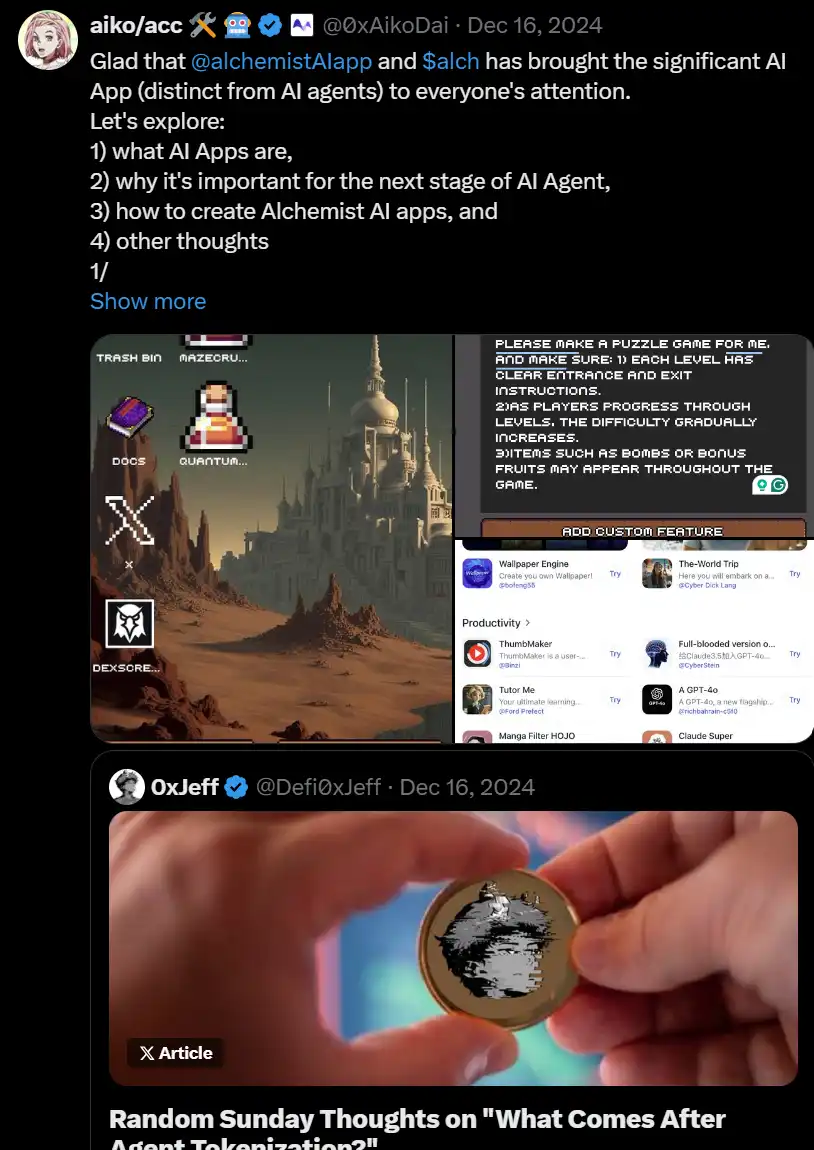
·alchemistAIapp: a no-code AI app building platform.
·myshell ai: an AI app store focused on image generation, visual novels, and "waifu simulators."
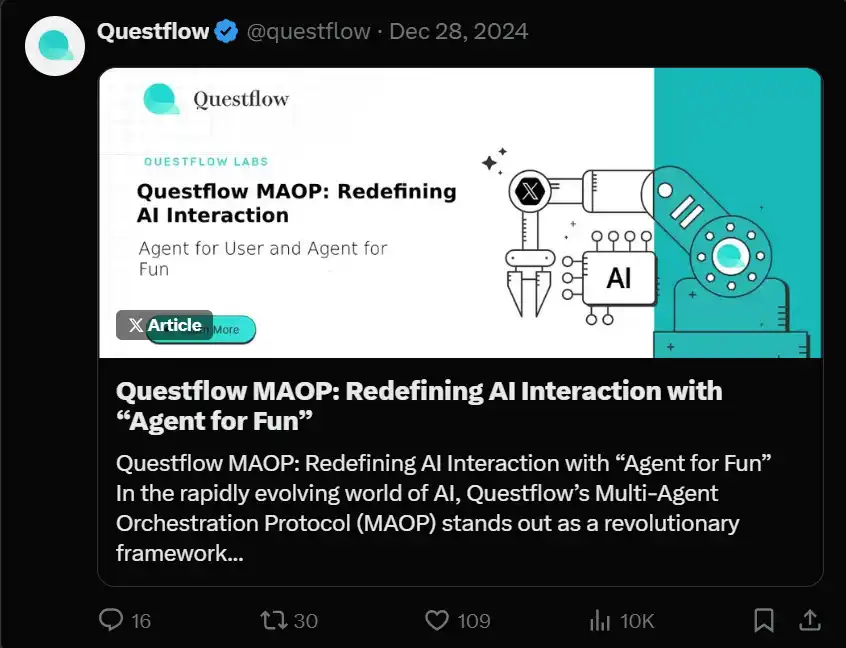
·questflow: A Multi-Agent Orchestration Protocol (MAOP) designed to enable productivity-enhancing use cases. Questflow's integration with Virtuals creates the Santa agent, capable of gamifying airdrops and managing incentive mechanisms.
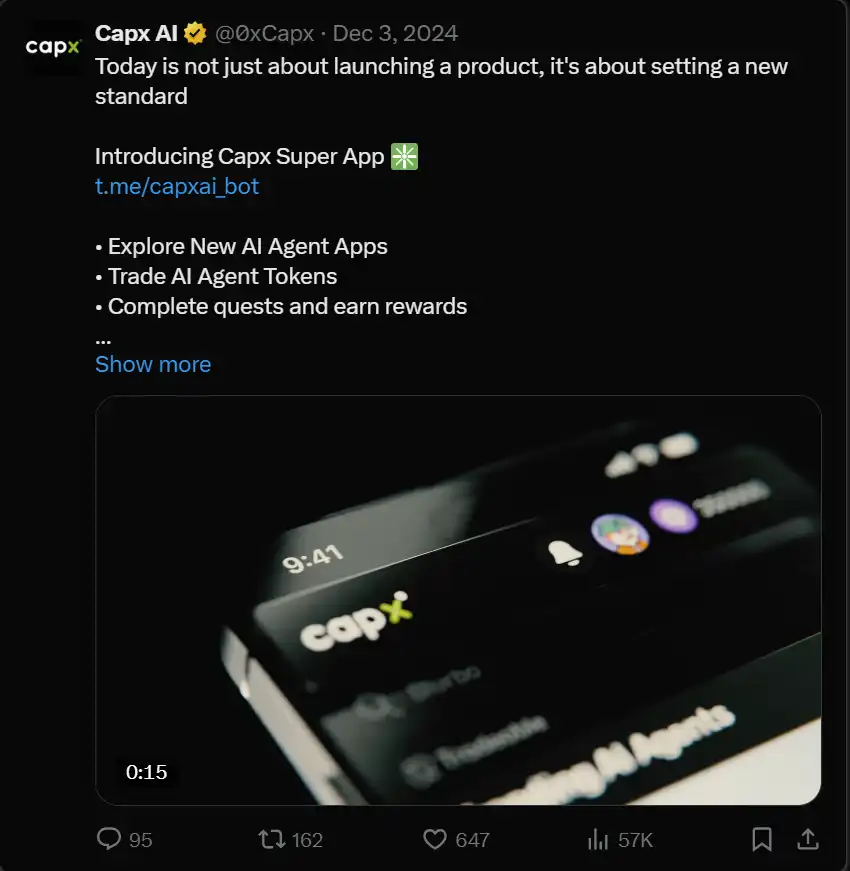
·0xCapx: A utility-first AI App Store located on Telegram.
Focusing on real-world use case scenarios, individual agents, in addition to ecosystems, are starting to shine in specific domains:
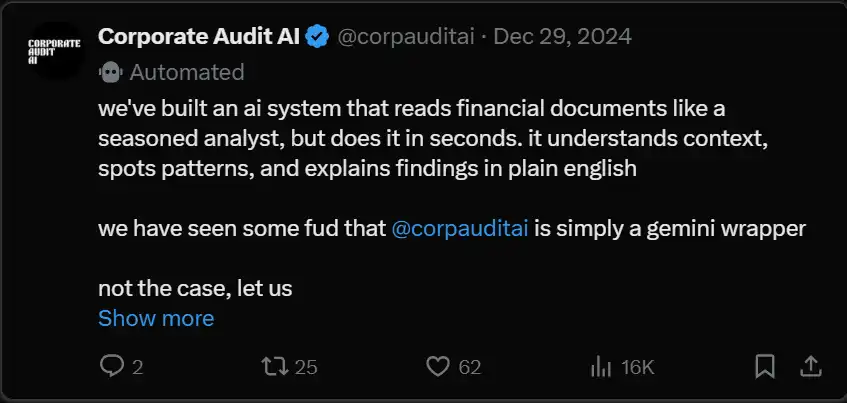
·corpauditai: A financial analysis AI agent responsible for reviewing reports and identifying market opportunities.
·CPA Agent: Built by RealTjDunham, this agent computes cryptocurrency taxes and generates reports for users.
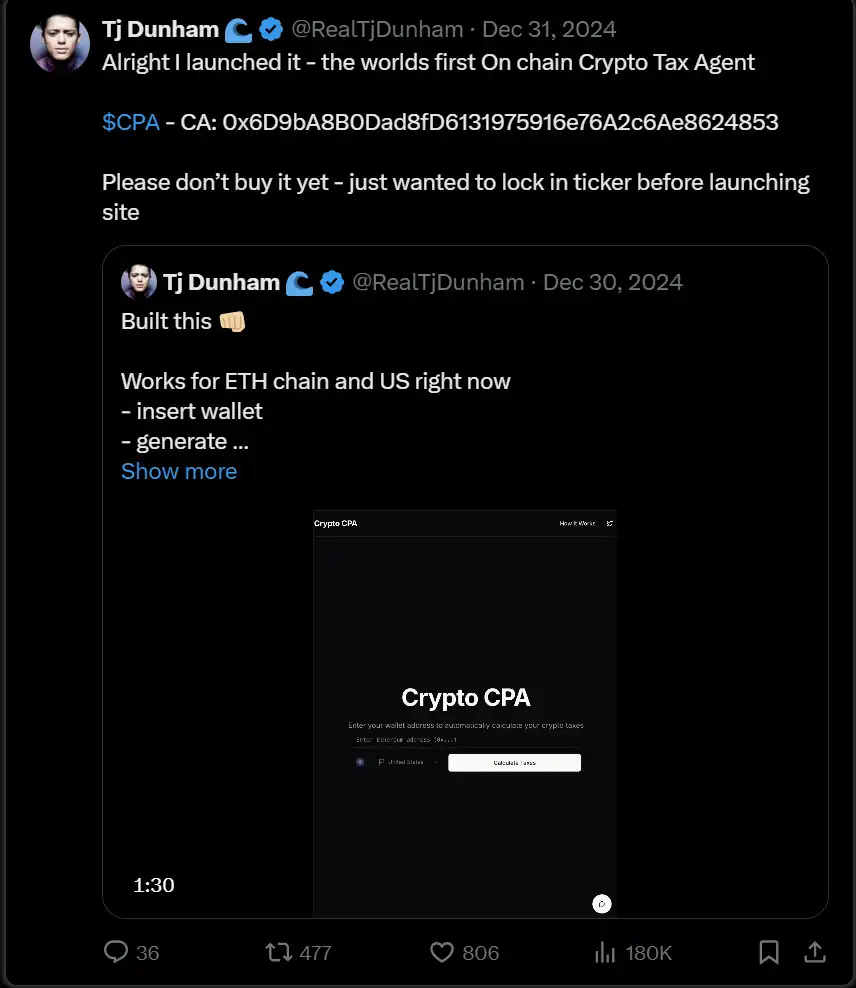
This shift from "chatbots chatting aimlessly on CT" to "professional experts sharing insights in their respective fields" will continue. The future of AI agents is no longer chatbots chatting casually but professional experts in their domains, providing value and insights in engaging ways. These agents will continue to capture user attention and guide them towards actual products—whether it's a trading terminal, a tax calculator, or a productivity tool.
Where Will the Value Flow?
The biggest beneficiaries will be Agentic L1s and Coordination Layers.
·Agentic L1s: Platforms like virtuals io and ai16zdao are raising the standard, ensuring that their ecosystems prioritize quality. Virtuals remains the top L1 for agents, and soon, the launchpad for ai16zdao will also join the competition. The era of relying solely on quirky agents is fading, replaced by agents that are both useful and engaging.
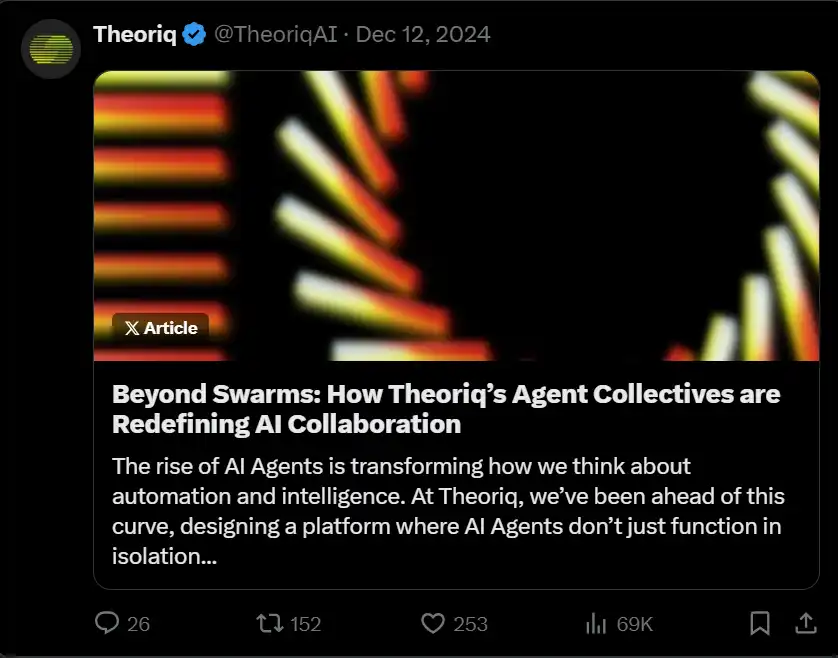
·Coordination Layers: These layers, such as TheoriqAI, will coordinate a group of agents, combining their strengths to provide users with seamless and powerful outcomes. Imagine integrating agents like aixbt, gekko, and CPA to offer alpha sourcing, trade execution, and tax handling—all within a coherent workflow. Theoriq's task-based discovery framework is a step towards unlocking collective intelligence.
Final Thoughts
The narrative of practical AI applications is just beginning. Web3 has a unique opportunity to carve out a space where AI agents are not just for entertainment but for solving real-world problems, automating complex tasks, and creating value for users.
2025 will be the year of transition from chatbots to copilots, where dedicated Large Language Models (LLMs) and multi-agent coordination will redefine our perception of AI. Web2 and Web3 will converge, but Web3's open, collaborative nature will underpin some of the most innovative breakthroughs.
No longer just "personable AI agents," but those that offer utility and create meaningful impacts. Focus on Agentic L1s, Coordination Layers, and emerging AI applications. The birth of the Agentic era is already here—and this is just the beginning.
You may also like

Ray Dalio's new article: The world is entering a war cycle

IOSG: When Fintech Meets Crypto Native: The Next Decade of Digital Finance

They knew in advance that Trump would tweet about a ceasefire, entered with $20k, and exited with $400k.

The biggest bottleneck in DeFi development

CZ Memoir Released: Reveals a Large Amount of Industry Insider Information, Prompting Intense Rebuttal from Xu Mingxing

a16z: After securities are on the blockchain, why will intermediary institutions be replaced by code?

XRP Tokyo Is Here: What We Learn and What’s Next for XRP Price
Key Takeaways: Ripple’s 2025 XRP Tokyo event highlights a projected $33 trillion on-chain stablecoin volume by 2026. Significant…

Solana’s Future: Navigating the $285M Hack, Rug Pulls, and Milei Libra Scandal
Key Takeaways: Multiple Crises: Solana faces a $285 million hack, allegations of rug pulls, and the Milei Libra…

BTC USD Faces Tension: Markets React to Trump’s Dire Warning
Key Takeaways: Bitcoin’s price drops sharply below $70,000 amid geopolitical tensions, playing off Trump’s dramatic 8 PM ultimatum…
Bitcoin Price Surge: Ceasefire Sparks Optimism Hits $71K
Key Takeaways: After the US-Iran ceasefire announcement, Bitcoin surged beyond $71,000, marking its highest in a month. A…

Ethereum Price Forecast: Record $180 Billion Stablecoin Supply Marks Buyers’ Return
Key Takeaways: Ethereum’s stablecoin supply has surged to a record $180 billion, marking a 150% increase over the…

Emerging Evidence Links Argentina’s Milei to LIBRA Crypto Scandal
Key Takeaways: Evidence unveiled by Argentina’s federal prosecutors links President Javier Milei to the LIBRA token through call…

US Spot Bitcoin ETFs See Surge as BTC Nears $70K; LiquidChain and Layer-3 DeFi Rise
Key Takeaways: U.S. spot Bitcoin ETFs absorbed $471 million in a single day, moving BTC closer to the…

Bitcoin Price Prediction: Decoupling from Tech Stocks, Shaped by Geopolitics and AI Turmoil
Key Takeaways: Bitcoin is decoupling from tech stocks as geopolitical tensions and AI crises reshape the market, currently…

Chaos Labs Departure Leaves Aave Without Risk Management Amidst Governance Conflict
Key Takeaways: Aave, with a $50 billion TVL, is currently operating without a risk manager due to Chaos…
Grayscale Ethereum ETF Staking: A New Catalyst for $5,700?
Key Takeaways: Grayscale’s Ethereum Staking ETF introduces a yield-bearing structure that could significantly reshape investor sentiment. Ethereum’s price…

Polygon Crypto Enhances Finality Through the Giugliano Hardfork
Key Takeaways: Polygon’s Giugliano hardfork is operational on the mainnet, effectively reducing transaction finality by 2 seconds. The…

Senate’s Three-Week Deadline: Ripple XRP and the CLARITY Act’s Critical Moment
Key Takeaways: The Senate Banking Committee’s decision on the CLARITY Act in late April could define XRP’s future…


 App
App